
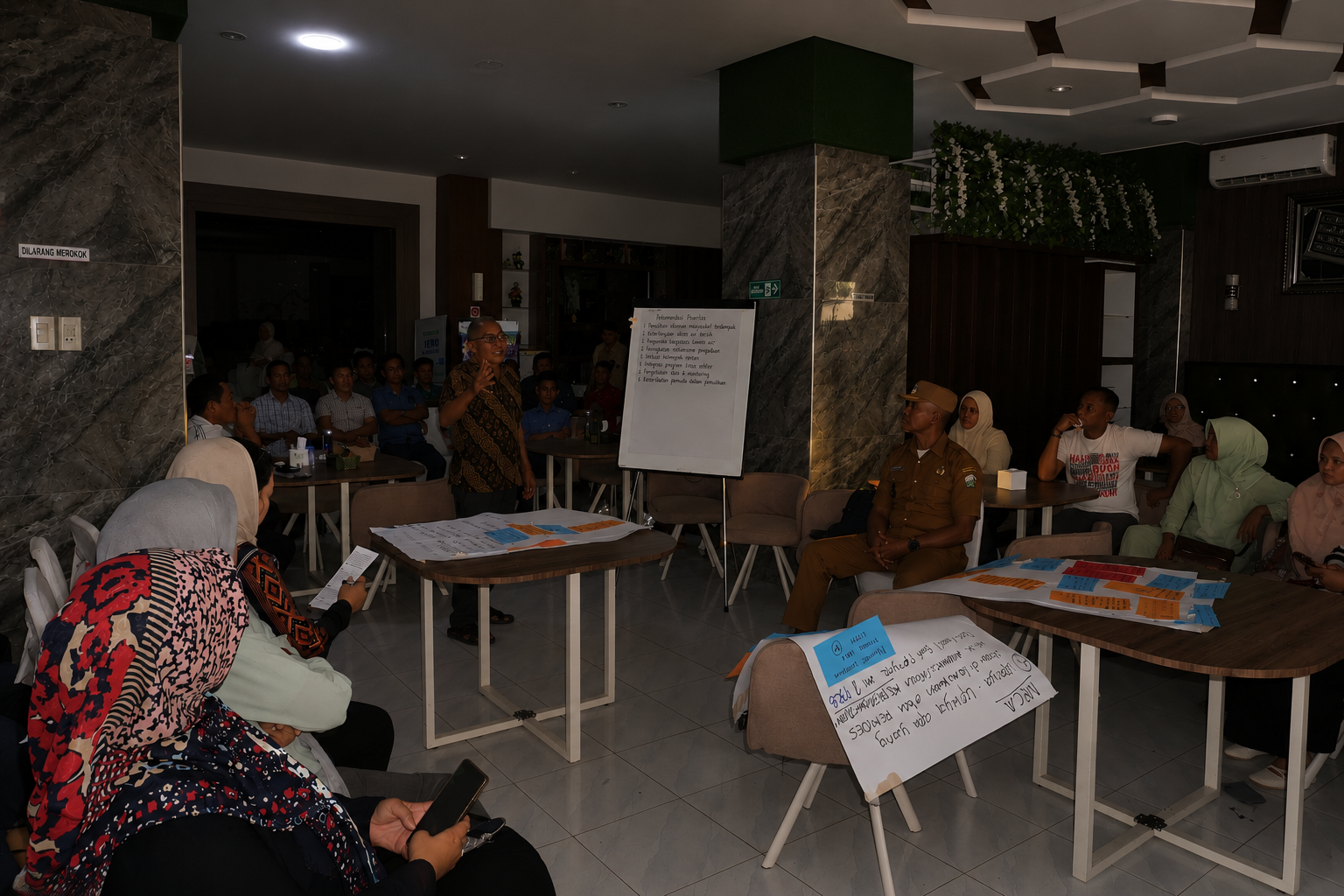
On the afternoon of June 4, 2026, the meeting hall of Hotel Fajar in Bireuen was filled with lively discussions. Dozens of participants worked together to develop recommendations based on lessons learned from the implementation of the Aceh Relief and Integrated Support in Emergencies Project—a collaborative initiative between Yayasan Fondasi Hidup and YAKKUM Emergency Unit (YEU) that supported flood-affected communities in Bireuen Regency from December 2025 to May 2026. The Learning Event provided a shared platform for participants to reflect on best practices, identify key challenges, and formulate recommendations to strengthen future humanitarian responses.
Participants came from a wide range of backgrounds, including representatives from local and village governments, village water committees, project participants of clean water assistance and MPCA (Multi-Purpose Cash Assistance), media representatives, and humanitarian organizations. They were divided into several Focus Group Discussions (FGDs), each facilitated by a facilitator and co-facilitator, where they reflected on their experiences throughout the implementation of the project. The objective was simple yet essential, to ensure that every voice contributed to a shared learning process and helped shape future humanitarian action.
As the afternoon drew to a close and the group presentations were nearing the end of the event, the room was suddenly plunged into darkness. The electricity had gone out. Within seconds, the meeting hall—filled with lively conversations since early morning—was enveloped in darkness. The air conditioning stopped. The microphones fell silent. The projector went blank. Only the fading afternoon sunlight filtering through the windows provided enough light to keep the room visible.
For a brief moment, everyone looked at one another. Yet no one stood up to leave.
Instead of bringing the event to a halt, participants simply lifted their discussion notes and carried on. The facilitators continued guiding the conversation, while each group representative remained ready to present the recommendations they had developed together. It was as if everyone shared the same understanding: the purpose that had brought them together that day mattered far more than the limitations of the facilities.
When it became clear that the electricity would not be restored anytime soon, everyone moved to the hotel lobby, where natural daylight still filled the space. Chairs were rearranged in a simple circle. There were no presentation slides, no microphones, and no projector—only the voices of participants taking turns to share the recommendations that had emerged from their group discussions.
In fact, it was precisely in this simpler room the essence of the event became even more apparent. The Learning Event was never intended to be merely a forum for presenting project achievements. From the outset, it was designed to document best practices, explore the challenges encountered throughout implementation, and generate practical recommendations drawn from the experiences of diverse stakeholders to strengthen future humanitarian responses. That is why every story shared by participants carried as much value as the project's data and reports.
Their lived experiences offered insights that no set of statistics alone could fully capture, enriching the collective learning that will help shape more effective and inclusive humanitarian action in the future.
The discussions continued despite the limitations. It was a simple yet powerful reminder that the spirit of learning does not depend on electricity, presentation screens, or even a comfortable venue. Instead, it is sustained by people who believe that experiences are meant to be shared—so that the lessons they carry can help prevent the same mistakes from being repeated in the future. In that moment, the unexpected power outage became more than just a disruption. It quietly reflected the very essence of humanitarian work: adapting to challenges, making the best use of available resources, and continuing to move forward with a shared commitment to learn and improve.
The disaster had already taught the people of Bireuen how to endure challenges far greater than a power outage lasting a few hours. Perhaps that was why, on that afternoon, no one complained. Their only concern was ensuring that every discussion reached its conclusion, every recommendation was heard, and every lesson from the ARISE Project could help strengthen future humanitarian responses.
Light does not always come from electricity. Sometimes, it comes from a group of people who choose to remain together—to listen, to learn from one another, and to keep moving forward even when the room around them has fallen into darkness. Perhaps that is the most enduring lesson of all: resilience is not only about overcoming adversity, but also about preserving the willingness to learn, adapt, and support one another—whatever challenges may arise.