
On 18 August 2026, the YAKKUM Emergency Unit (YEU) team arrived in Flores together with a medical team to support communities affected by the earthquake. In the following days, the team focused on conducting rapid needs assessments in Manggarai and East Manggarai. Through these assessments, we wanted to better understand the needs of communities, especially those who were most vulnerable and still living in difficult conditions after the earthquake.
At the same time, the medical team, consisting of one doctor and two nurses from Bethesda YAKKUM Yogyakarta Hospital, visited areas prioritised by the District Health Office. Many people were still staying in tents and other temporary shelters. These conditions increased their risk of illness, while access to health services had not yet fully returned to normal.
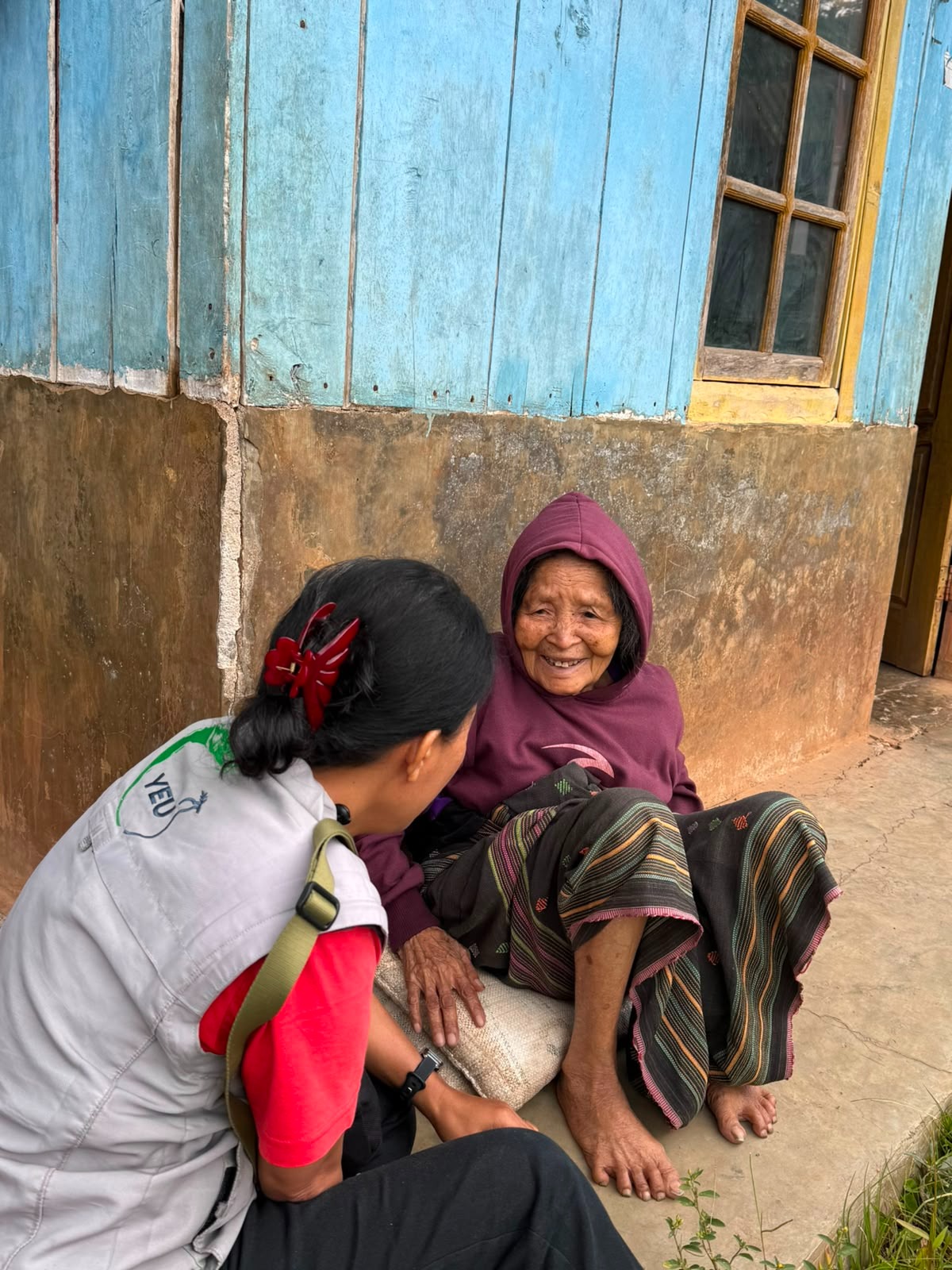
During our needs assessment in East Manggarai on 22 August 2026, we arrived in Golo Lero Village, Lamba Leda Timur District. The village was one of the areas with significant damage to houses. Among the damaged homes, we met an older woman named Oma Lusia Inus, 86 years old. Oma Lusia Inus, 86 tahun.
Oma Lusia has difficulty walking and cannot move steadily. She needs to be supported when she walks. Since the earthquake, she has spent most of her time sitting in front of her house because she cannot move quickly like other people.
We found Oma Lusia sitting in a corner of her house. Her seat was very simple, a mattress covered with a sack. This is where she spends most of her time during the day, staying alert in case another earthquake happens.
What touched us most was when Oma told us about the nights.
If an aftershock happens at night, Oma cannot run outside with the others. Because of her limited mobility, she chooses to stay inside her room. She can only surrender herself to God, pray, and hope that she will be safe.
For many people, running outside during an earthquake may seem like a simple thing to do. But for Oma Lusia, it is not easy. Her age and physical condition limit her ability to move. Every tremor brings fear, while also reminding her that she cannot quickly get herself to safety.
Yet, in the middle of this helplessness, we saw something else: her faith remains strong.
Oma Lusia does not know when the earthquakes will finally stop. She does not know when her home and daily life will return to normal. She also does not know when the next assistance will arrive. But whenever fear comes with another tremor, she chooses to pray.
Meeting Oma Lusia reminded us that disasters do not choose who they affect. An earthquake can affect anyone, but its impact is not the same for everyone. For an older person who already has difficulty walking, each tremor can bring much greater fear because their ability to move quickly and reach safety is very limited.
In a situation that is still uncertain, we also saw how important the people around us can be. When someone can no longer move or act independently, support from family, neighbours, and the wider community becomes very important. Simple acts of care, helping someone walk, checking on their needs, staying with them, or simply being there, can become a source of strength for those who are most vulnerable.
Oma Lusia may not be able to run when an earthquake comes. But she continues to face the situation in her own way: with prayer, with faith, and with the support from people around her.
For us at YEU, meeting Oma Lusia was more than just part of a needs assessment. She reminded us that behind every number, damage assessment, and count of displaced people, there is a person with their own story and struggle. And while no one knows when assistance will arrive or when life will return to normal, faith and a caring community can become an important source of strength to keep going.