
Climate change and disasters are no longer merely issues on paper. Their impacts are present and directly felt in the daily lives of village communities in Pati Regency—on agricultural land, fishponds, coastal areas, and even within the domestic spaces of households.
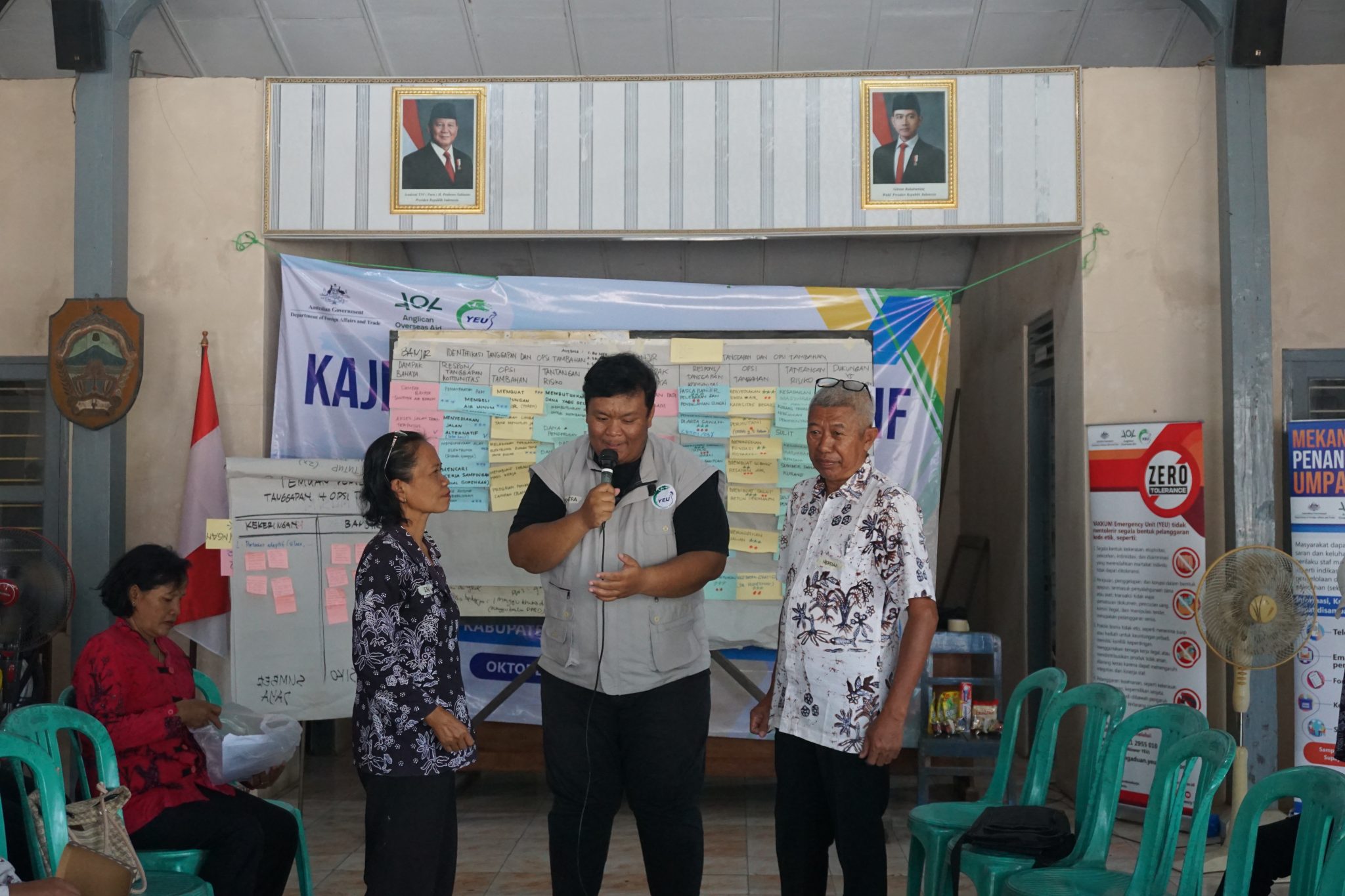
From 27 October to 21 November, four villages in Pati Regency—Tegalombo, Keboromo, Tunggulsari, and Banyutowo—took part in a Participatory Assessment of Climate and Disaster Risks (PACDR). This process was designed as a shared learning space that encouraged villagers to exchange experiences, identify the risks they face, and collectively formulate ways forward.
Together with the YEU team, the four villages carried out a series of participatory discussions and local knowledge–based mapping activities to identify the main hazards in each area. PACDR activities were conducted over five days in each village, with particular attention to differences in perspectives between women and men. Each village involved around 30 participants, ensuring gender balance and the inclusion of persons with disabilities.
The PACDR process included mapping village-level resources and hazards, developing seasonal calendars, preparing hazard impact matrices, presenting climate change trends, identifying additional risk reduction options, compiling a synthesis report, and developing community action plans. Community members actively participated in all of these activities. Throughout the PACDR process, villagers served as the primary resource persons, sharing critical information on hazards and their impacts based on their everyday experiences.
At the end of the process, each village successfully identified two main hazards. One hazard that emerged across all four villages was tidal flooding, highlighting that it remains a serious challenge for coastal communities in Pati. However, PACDR did not stop at risk identification alone. Community members were also actively involved in developing action plans—concrete steps to be undertaken collectively to reduce risks and address the impacts of existing hazards.
The PACDR process created space for villagers to listen to one another, learn together, and strengthen shared understanding. The experiences of Tegalombo, Keboromo, Tunggulsari, and Banyutowo affirm that when communities are engaged from the outset, resilience becomes not just a concept, but a lived practice rooted in everyday life.