
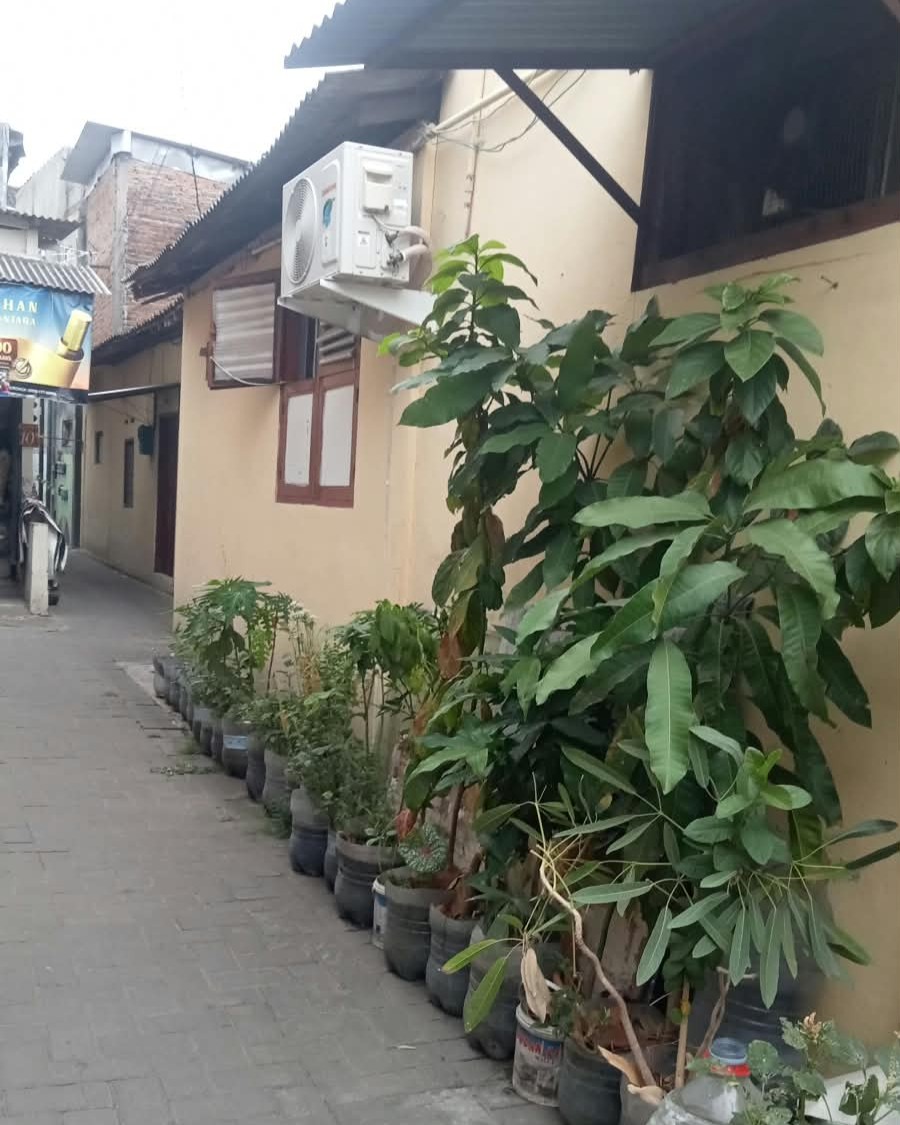
Today, Mbok* Minah has replaced rice with boiled sweet potatoes. Her husband is out of work, and their financial situation is getting worse.
The morning sun began to shine on the corrugated metal roof of Mbok Minah’s house. The metal roofing made the house even hotter.
Mbok Minah hurried into the narrow kitchen to prepare breakfast. She had a basket of sweet potatoes that she had grown in a plastic water-gallon container on the narrow strip of space beside her house. After washing them, she put the sweet potatoes on to boil. While waiting for them to cook, she prepared a pot of hot tea for her husband and family.
Her husband had been out of work for almost a month. It was not because he was unwilling to work, but because construction projects, the source of his livelihood, had become scarce. The rice supply at home was also running low, so Mbok Minah had started serving boiled sweet potatoes as an alternative for breakfast.
Once the sweet potatoes and hot tea were ready, Mbok Minah hurried to the wooden dining table, which was beginning to sag with age. She and her family had lived in Yogyakarta for more than 20 years, hoping to build a better life in the city.
For almost five months, the air in the city had felt hot and stuffy. Perhaps the dense population and lack of greenery, due to limited land, were contributing to the uncomfortable heat in the narrow alleys where Mbok Minah lived.
“Pak*, how is work going? Is construction busy or quiet these days?” Mbok Minah began the conversation over breakfast, with boiled sweet potatoes and a cup of tea.
“It’s quiet, Buk! Right now, I’m only helping Mr.Ngatijo build a fence around his house,” her husband replied quietly.
Mbok Minah lowered her head, looking dejected, but she knew she could not blame her husband.
“When we first moved to the city in 2006, it wasn’t this hot, was it, Pak?” she remarked, wiping away the sweat trickling down her face as she stood by the stove.
“Back then, near the Gajah Wong River, there were still rice fields and shady breadfruit trees, Buk. The air was much cooler. Whenever we felt hot, we could just go down to the riverbank and sit under the shade of the breadfruit trees,” her husband explained.
“Pak, next month is the deadline for paying our children’s school fees,” Mbok Minah continued.
“Hmmm…” her husband murmured. “be patient, when I get paid, I’ll try to borrow some extra money from my boss.”
Their children then emerged from their bedroom and headed to the bathroom to get ready for the day.
Mbok Minah had two daughters, both of whom were still in school. Her eldest daughter was studying at a private university in Yogyakarta, while her youngest was in fifth grade at a public elementary school.
After bathing, the girls hurried to the dining table for breakfast. It happened to be a public holiday that Tuesday, so they did not have to go to school.
To save cooking oil, Mbok Minah had deliberately chosen to boil the sweet potatoes she had at home rather than fry anything. She also wanted to reduce the amount of fried food her family ate, both for their health and to help her husband and children understand that boiled food could be a healthier choice.
"Nduk!* Mbok Minah called to her daughters.
“Come on, have the breakfast we have today. We should be grateful that we can still eat breakfast, even if it is only boiled sweet potatoes and a cup of tea.”
The girls did not look particularly enthusiastic when they saw what was on the table.
“Is this really all we’re having for breakfast, Buk?” the younger daughter grumbled.
With a displeased expression, she nevertheless picked up her cup of tea and took a piece of warm boiled sweet potato from the plate.
“Yes, dear. We’re having sweet potatoes this morning because our rice supply is running low,” Mbok Minah replied.
“Come on, just eat what we have. Don’t complain so much,” the eldest daughter chimed in, knowing that her younger sister was rather fussy about food.
Mbok Minah and her husband exchanged glances as they watched their daughters begin to argue over breakfast.
Her husband got up from the table and prepared the tools he needed for his work as a construction laborer in Yogyakarta.
“Buk, I’m off to work,” he said as he said goodbye to Mbok Minah and the girls.
“All right, Pak. I hope you can borrow some money from your boss today to help pay the school fees and cover the girls’ other school expenses,” Mbok Minah replied, taking her husband’s hand and bringing it to her forehead as he prepared to leave for his construction job.
After her husband left, Mbok Minah cleared away the remains of breakfast. Once she had finished tidying up, she approached her two daughters, who were still sitting near the dining table.
"Nduk, there’s something I want to talk to you about,” she began gently.
“We’ve been living in this city for years, and your father is still working as a construction laborer. Our living conditions haven’t really improved,” Mbok Minah said, staring into the distance.
“So, what should we do, Bu? I’m still studying,” the eldest daughter replied. “should I look for a job to help bring in some extra income for our family?”
“Yes, you should look for a part-time job, I can’t work yet because I’m still in elementary school.” the younger daughter chimed in with a cheeky grin.
“That’s all right, dear. If you want to work while studying at university, you can,” Mbok Minah said with a smile.
“Okay, Buk. I’ll start looking for job vacancies. Hopefully, I can find something that matches my skills,” the eldest daughter replied.
Mbok Minah moved closer to her daughters and hugged them.
“Girls, how about we use our free time to collect discarded plastic gallon containers and grow vegetables and other plants that can help meet our everyday kitchen needs?”
“I agree, Buk!” the younger daughter shouted enthusiastically.
“This afternoon, I’ll look for used plastic gallon containers at the grocery store across the road.”
“All right. You can take care of finding the plastic gallon containers, and I’ll find the soil and fertilizer so we can start planting in them,” the eldest daughter added excitedly.
Mbok Minah was delighted to see her daughters’ enthusiasm.
“Ya Allah, I’m so grateful to have such obedient and supportive children who are willing to support their parents’ ideas,” she murmured softly.
Mbok Minah began preparing a small hand trowel and the other tools they would need to plant vegetables and other crops the following day.
Finally, Sunday arrived. It was the day Mbok Minah and her daughters had set aside to begin gardening in the narrow space along the veranda of their home, in a densely packed neighborhood.
Dewi, the younger daughter, and Dinda, the eldest, were full of enthusiasm. They began filling the plastic gallon containers with soil and manure they had purchased from a plant shop not far from their home. They prepared seedlings and planting materials for sweet potatoes, chili peppers, tomatoes, eggplants, spinach, water spinach, and other vegetables, then planted them in the containers.
Mbok Minah’s husband, Bimo, joined in to help his wife and daughters.
After two months, the plants they had grown were beginning to look green and flourish. Bimo and Mbok Minah smiled as they admired the results of their family’s gardening efforts. Dinda and Dewi were delighted, too, to see the area around their veranda becoming greener.
It turned out that the desire to improve their lives had to begin with their own family.
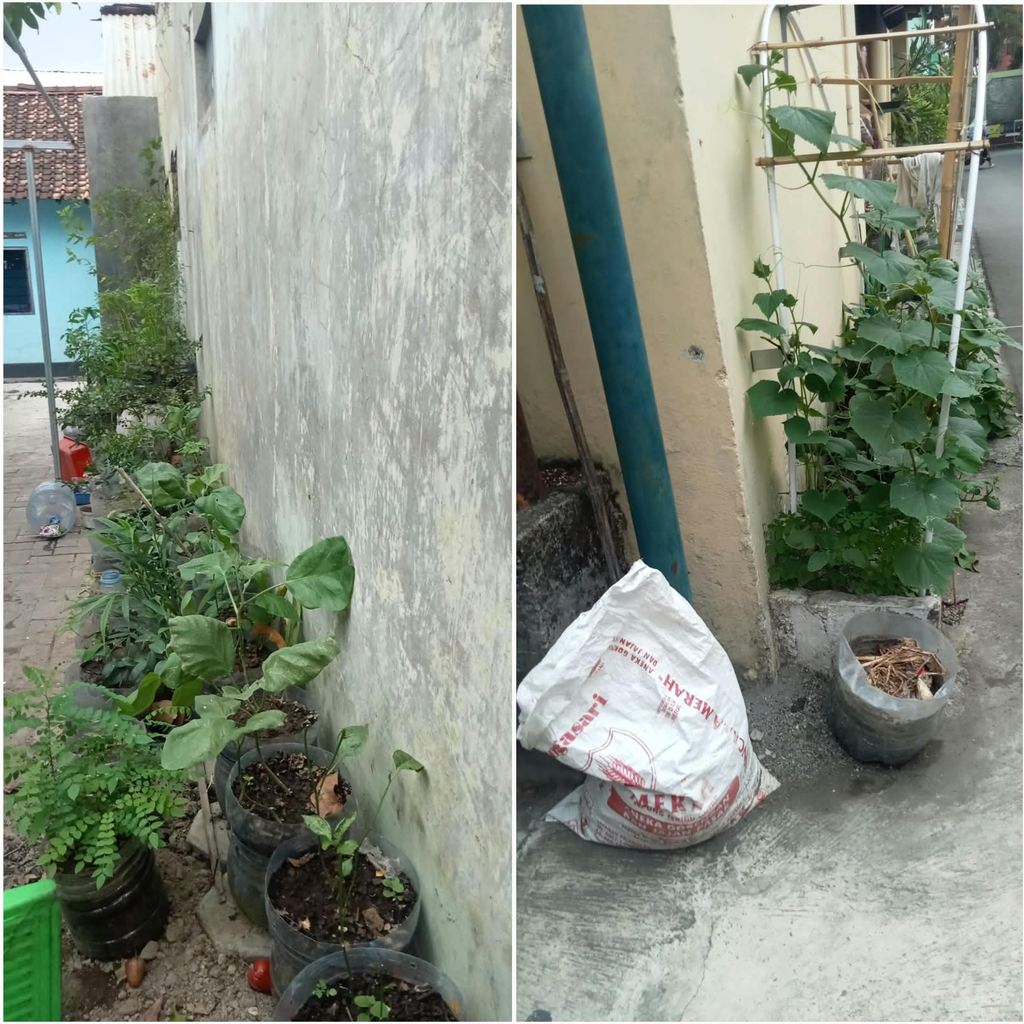
Photo 1. Vegetable cultivation using repurposed plastic water gallons as planting containers in the alleys between houses.
Soon, many of Mbok Minah’s neighbors began following their example and growing leafy vegetables in the narrow spaces outside their homes. Some came to Mbok Minah’s house to learn how to grow vegetables using plastic gallon containers with a wick-based watering system. They then began putting what they had learned into practice in the alleyways near their homes.
The city’s once-bare alleyways gradually became greener and more pleasant to look at. The neighbors were also grateful to Mbok Minah’s family for initiating small, positive changes that helped reduce their household food expenses.
Their neighbors’ growing interest in planting vegetables was not without reason. They had begun to realize that the climate and weather were different from what they had experienced in previous years.
In the past, the dry season had not felt as severe or as hot as it does today. Perhaps rising temperatures, the increasing number of buildings in urban areas, the loss of green spaces, and the growing number of vehicles had all contributed to the change.
Mbok Minah and her neighbors began to realize that strengthening food security starts with the willingness and commitment of people in their own neighborhoods. Today, these gardens growing on concrete surfaces have become a source of hope for food security and greener urban communities.
*Mbok is a traditional Javanese term of address used to refer to or address a woman, particularly an older woman.
*Pak is a Javanese form of address for adult men, commonly used as a formal expression of respect, particularly for those who are married.
*Buk is a Javanese form of address for adult women, commonly used as a formal expression of respect, particularly for those who are married.
*Nduk is a Javanese term of endearment used to address girls or younger women, particularly by parents when addressing their daughters.
Editor: Luviana Ariyanti
This article is a collaboration between YAKKUM Emergency Unit (YEU) and Konde.co as part of the #Kedip program, or Konde Women’s Digital Literacy.