
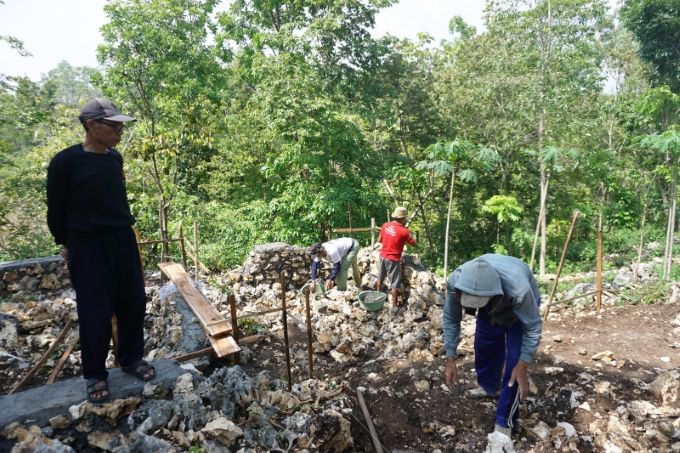
Temon Hamlet, Giripurwo Village, Purwosari Subdistrict, Gunungkidul Regency, Special Region of Yogyakarta, Indonesia.
Process and Challenges
As weather patterns continue to change due to climate change and increasing water scarcity, farming communities around the world are being forced to innovate. For regions with unpredictable rainfall and challenging topography, innovative and effective water management is essential to ensure the long-term sustainability of agriculture. One such innovation is the Smart Fog Irrigation System with Rainwater Harvesting, an effort that focuses on optimising water conservation in drought-prone areas. However, implementing this system is not easy, especially in areas with challenging geographical conditions, such as in Temon Hamlet, where seasonal and geographical factors add to the complexity of the construction process.
The development of a smart fog irrigation system with rainwater harvesting in Temon Hamlet reflects the challenges of overcoming water scarcity through innovative yet realistic infrastructure. One of the main challenges in developing this system is the geological characteristics of the area. Temon Hamlet is located on karst land dominated by highly porous, rocky, and uneven limestone. These conditions make foundation and excavation work very difficult, as the rocky terrain hinders the excavation, construction, and installation processes. In addition, the location of the irrigation system in the hills adds to the difficulty of transporting building materials. Transporting materials such as cement, pipes, and equipment up the hill through rocky terrain requires extra effort and poses a challenge in itself.
The challenges increased because construction took place during the rainy season. Regular rainfall not only makes the ground slippery and dangerous, but also increases the risk of injury from wet, sharp rocks. As explained by Suwarno, a farmer from the Rukun Santoso group, "Because it is the rainy season, the slippery conditions increase the risk, and wet, sharp rocks can also injure our hands." In addition to worker safety issues, the rain also poses technical challenges. Rainwater can interfere with the cement drying process, so the farmer group must take extra precautions, such as covering the cemented area to prevent erosion. These additional steps increase the workload and prolong the construction completion time.

Another major obstacle is transporting water tanks to the construction site. Due to the hilly topography, the use of mechanical equipment is not possible, leaving farmers with no choice but to rely on manual labour. At the steepest and rockiest points, water tanks must be carried manually, while on gentler slopes, wooden poles are used as temporary support structures to help distribute the load.
In addition, walking across cultivated land poses its own challenges. Too many people can damage crops and reduce yields in the area. To overcome this, farmer groups have developed an adaptive solution—moving water when it rains. This way, plants can bend temporarily underfoot without breaking and have a chance to recover after the rain stops, minimising crop damage.

Another challenge faced is the limited internet connectivity for CCTV. Although the village already has internet access, the available connectivity is insufficient for installing CCTV, which requires a minimum speed of 5 Mbps. Currently, the area can only provide a speed of 1 Mbps.
The use of CCTV is very important for securing IoT devices and enabling farmers to monitor conditions in real time and ensure that irrigation systems are functioning properly when it is time to water the crops. Currently, solutions to this problem are still under consideration and the search for the right solution is ongoing.
Despite facing significant challenges, the development of the Smart Fog Irrigation System with Rainwater Harvesting is an important step towards sustainable water management in this region. This project not only demonstrates the resilience and creativity of local farmers, but also emphasises the importance of developing climate-smart agricultural infrastructure that is adapted to environmental conditions. Their commitment to building a resilient future is a source of inspiration, reminding us that by implementing sustainable practices and strengthening community collaboration, we can create a world where the agricultural sector continues to thrive in the face of climate change.
—————
Author: Nanda Annisa Husni – Information and Communications Officer