
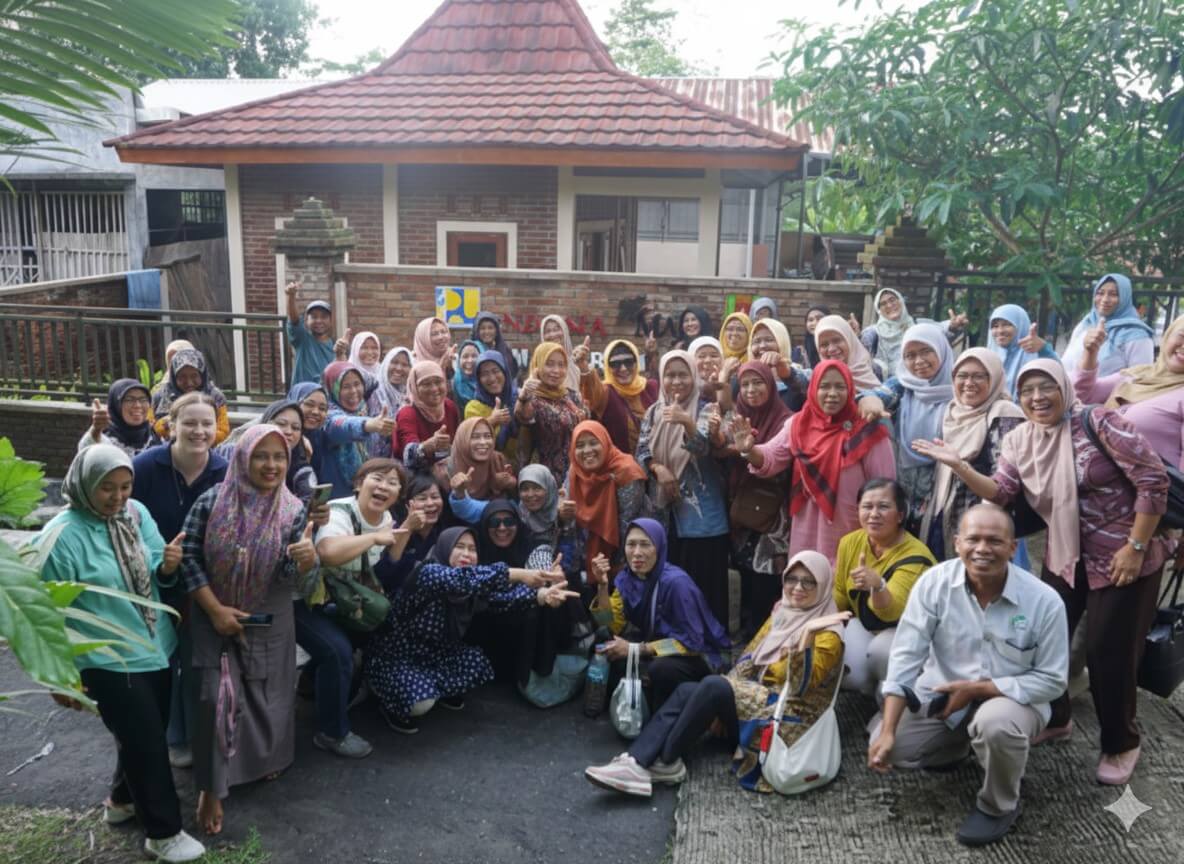
Barokah Waste Bank is one of the Reduce, Reuse, Recycle (3R) Waste Disposal Sites located in Nglumut Village, Magelang Regency, Central Java. On Tuesday, 5 November 2024, 66 participants consisting of women from partner groups, along with the YAKKUM Emergency Unit (YEU) team, gathered at the Nglumut Asri TPS 3R building. This waste bank is one of the waste disposal sites in Magelang Regency that has been supported by the Public Works Agency.
This activity is part of peer learning between women's groups in the Special Region of Yogyakarta and Central Java. It is part of the Huairou Commission Project to strengthen women's capacity as leaders in climate change adaptation and disaster resilience, including hydrometeorological disasters.
The objectives of this activity include exchanging experiences and learning best practices from other groups in order to improve knowledge and skills among groups. In addition, this activity also provides opportunities for urban and rural farmer groups to share knowledge. This activity also serves as a networking platform for women's groups.
Barokah Waste Bank: Beginning with Helping, Until Finally Being Helped

This peer learning exchange activity was opened by the Head of Nglumut Village, Imros Suheri. He explained that the 3R waste sorting facility originated from the Barokah Waste Bank activity in Nglumut Village. Eventually, the Barokah Waste Bank was established and received guidance from the YAKKUM Emergency Unit in 2017. Before the TPS 3R building was constructed, waste sorting activities were still carried out in residents' homes. However, after the regent issued a regulation that every village must have a waste bank, the waste bank began to receive funding through village funds. Over time, the Barokah Waste Bank group submitted a funding request through its network of Members of Parliament to establish the TPS 3R in Nglumut Village. The TPS 3R Nglumut was built using a budget of six hundred million rupiah from the Public Works Department.
During the learning sharing session, Didik, as the head of the Barokah Waste Bank, explained that the 3R TPS building has been around since 2020 and began operating actively in 2021. For three years, Bank Sampah Barokah has been operating, still relying on operational costs from the community. The community pays £15,000 per month for operational waste transportation needs, until finally, £15,000,000 per year was budgeted from village funds to finance Bank Sampah Barokah's activities. According to Didik, the waste bank was initially like a social service initiative, meaning it did not receive any funding annually, until it gradually began to receive financial support from the village government for the bank's administrators.
Good practices that have been implemented by Bank Sampah Barokah include building relationships and networking. During the sharing session, it was explained that communication networks and advocacy power were among the factors that drove the establishment of the Nglumut 3R waste collection point. In addition, during the development of the waste bank, the power of networks and relationships was also used in determining collectors who were willing to pay for their plastic waste at a standard price. Furthermore, transparency in transactions at the outset is crucial, where the pricing of plastic waste and used goods is agreed upon by the collectors and the waste bank.
Several participants were members of waste banks in their respective villages. A frequently asked question was related to the pricing of plastic waste and other used items. The obstacle faced by waste banks in Yogyakarta is that the prices set by collectors tend to be low and are considered unprofitable for waste banks. "The price of plastic waste tends to decline, but if the waste is sorted properly, this is not actually the case," explained Atik Pratiwi, chair of the environmental movement in Magelang Regency.
Peer Learning: Concrete Action to Address Climate Change

Peer learning was conducted by dividing the participants into two classes. The classes were facilitated by Lucy Okyta Purba, chairperson of the Gempita Waste Bank, Suryatmajan, Yogyakarta; Syarifah Anggreini, chairperson of the Migunani Suryatmajan Farmers Group (KT); Warsilah and Pertiwi Hidayati, from the Watugajah Women Farmers Group (KWT), Gunung Jati, Gunungkidul; Wartini and Ismi from the Girimulyo Women Farmers Group (KWT). During the learning session, each facilitator explained how the waste management process works in their respective groups.
The classes were also divided into two sessions in the morning and afternoon after a break. The morning session focused on presentations and sharing of learning experiences by the Gempita Waste Bank Group and the Migunani Farmer Group. In the afternoon, the session continued with a joint practice of processing organic waste into organic fish feed by KWT Girimulyo. In addition, there was also a practice of making Local Microorganisms with KWT Melati Watugajah.
—————
Author: Devina Prima Kesumaningtyas – Information and Communications Officer