
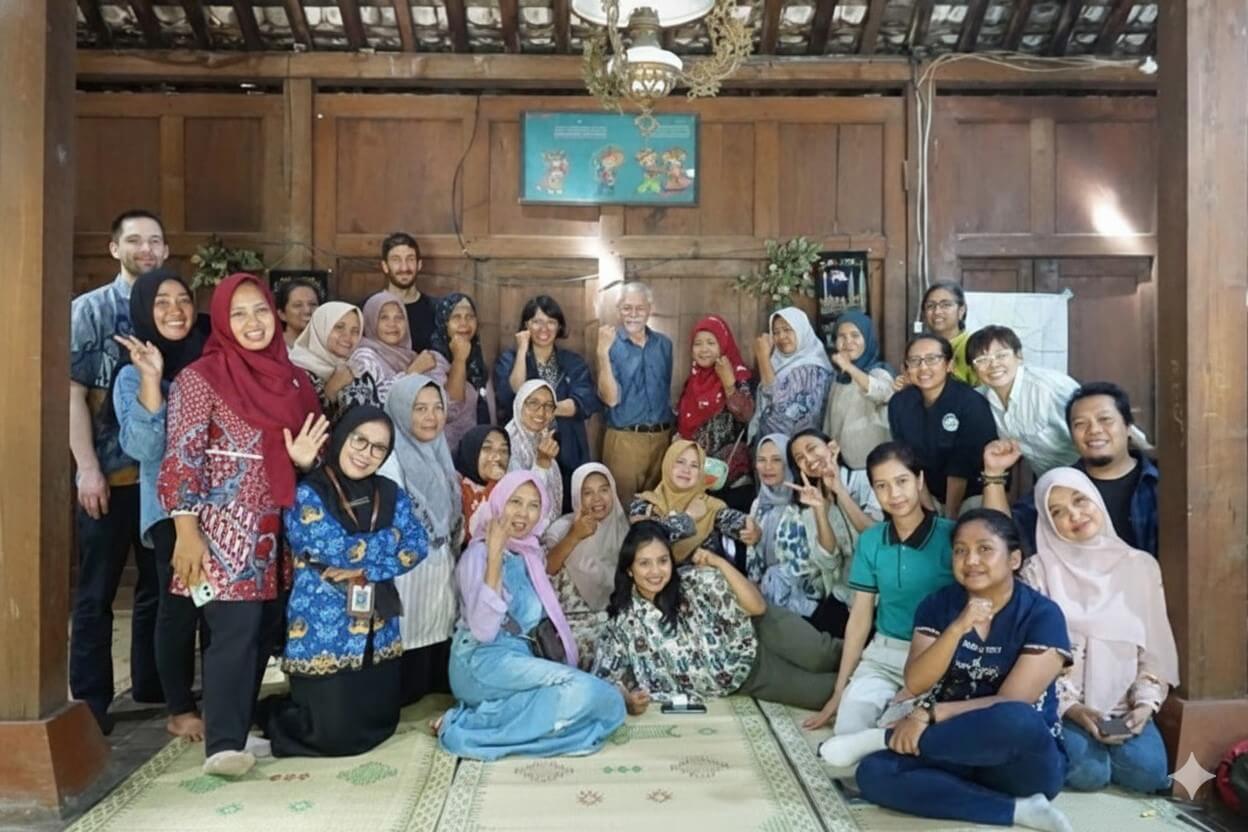
On 28-29 November 2024, the Huairou Commission (HC) together with the Asian Development Bank (ADB) conducted a monitoring and evaluation mission visit. The purpose of this activity was to assess the progress of the CRPP project in Indonesia. The CRPP is a project that aims to increase government investment in the resilience of poor and vulnerable communities affected by climate change. Specifically, this project focuses on learning from transformational solutions at the community level that explicitly address the intersecting impacts of climate, gender and poverty.
Presentation of the Performance of the Women's Working Group for Resilience Action in DIY

Members of the Working Group gathered at Mrs. Syarifah's house on 28 November 2024 to attend a discussion with ADB and HC. During the event, the women members of the DIY Working Group presented their performance during June-October 2024. They also outlined the changes they had experienced since joining the POKJA, as well as their contributions to the Community Resilience Partnership Programme (CRPP) project.
Since the project began, POKJA members have contributed to consultations on community disaster risk assessment tools and vulnerability assessments in the community. They have also been actively involved in the disaster risk assessment discussion process as facilitators in the group. Their involvement has had a positive impact, such as increasing understanding of the risks of disasters caused by climate change. In addition, they have been able to map problems, threats, risks, and ways to overcome or reduce the impacts.
Presentation by Representatives of the Gunungkidul Women's Group for the CRPP Project

The visit continued on 29 November 2024, in Kalurahan Girimulyo, Gunungkidul to continue data collection with YEU's women's partner groups for the CRPP project. Musidah, chairperson of the Mulyo Mandiri group, explained how the learning and resilience activities were carried out in their village. Starting with a disaster risk assessment conducted in May 2024, they mapped the disaster risks in their village. The disasters mapped focused more on hydrometeorological disasters, with drought being the most impactful threat. They also conducted a vulnerability assessment. The assessment was carried out using a survey method conducted on vulnerable groups. From the results of the disaster risk assessment and vulnerable group assessment, they were able to determine the resilience actions that could be carried out together. They have also prepared proposals for funding their resilience actions to YEU, HC, and ADB. The Mulyo Mandiri Women's Group also held a local dialogue with the Girimulyo Village government in September 2024.
The presentation continued with a presentation by Triyanita, representative of the Mertelu Resilient Women's Group from Mertelu Village. Similar to Girimulyo Village, which began implementing the programme with a disaster risk assessment and vulnerability assessment, Tri Yanita's presentation also included their views on vulnerability, particularly in the face of climate change. Through this perspective, new vulnerable groups emerged, such as farmers, women, independent elderly people, and people with disabilities. Farmers are one of the vulnerable groups because they rely on income from farming. However, during the dry season, agricultural land is prone to drought, resulting in crop failure. In addition, drought can lead to an increase in household needs. Families who do not own assets such as land or livestock are vulnerable to taking out loans to meet their needs.
——————
Author: Devina Prima Kesumaningtyas, Information and Communications Officer