
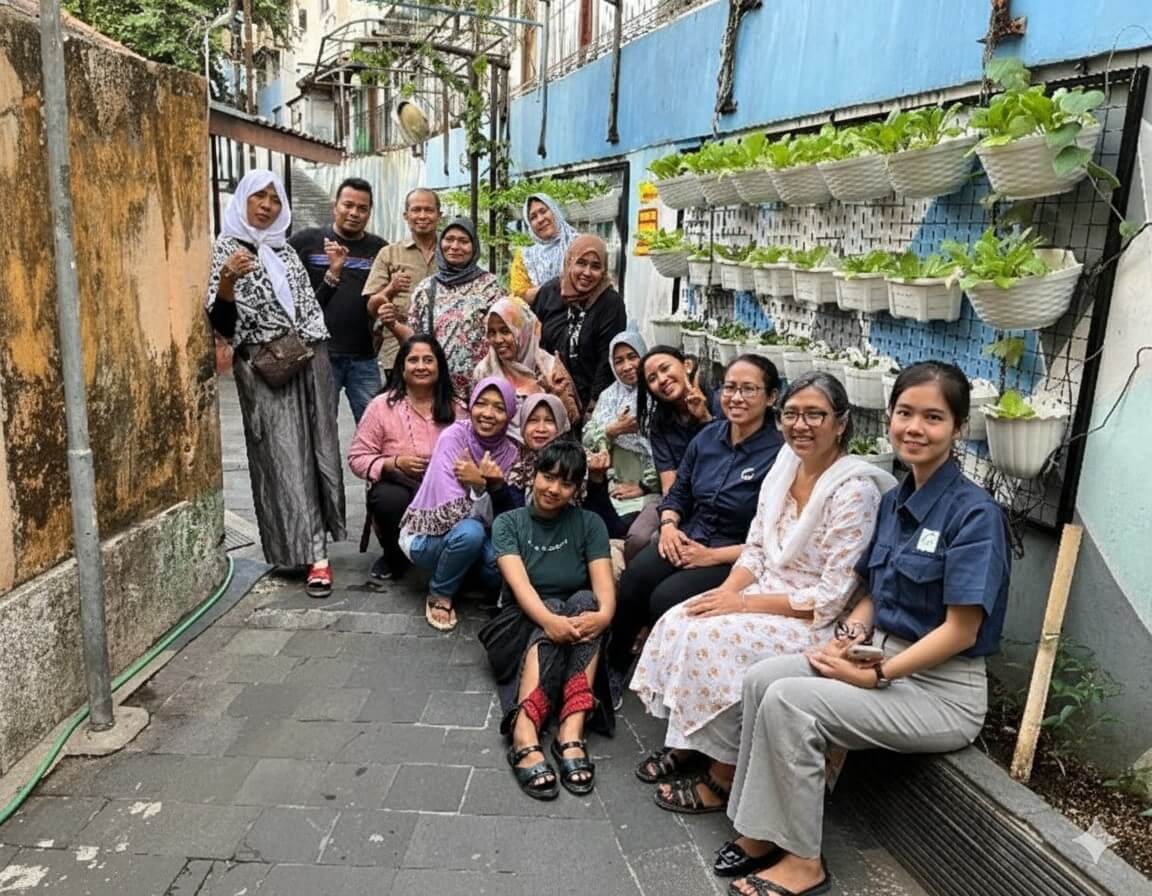
YAKKUM Emergency Unit (YEU) sebagai salah satu mitra Huairou Commission (HC) telah bekerja sama selama 9 tahun, dan telah membantu pemberdayaan lebih dari 66 kelompok perempuan di DIY dan Jawa Tengah. Dengan pendanaan yang diberikan oleh Asian Development Bank melalui HC pada tahun 2024 YEU melakukan Program Kemitraan Ketangguhan Masyarakat (CRPP) di 5 Kalurahan di Gunungkidul. Pada tanggal 9 – 11 September 2024, tim Huairou Commission melakukan kunjungan ke mitra-mitra di Indonesia, yang merupakan kelompok dampingan YEU.
The CRPP project itself aims to increase government investment in the resilience of poor and vulnerable communities affected by climate change. In particular, this project focuses on learning from transformational solutions at the community level, which explicitly address the intersecting impacts of climate, gender and poverty.
Suranjana Gupta and Ratna Mathur, consultants for the SIDA and CRPP projects, had the opportunity to engage in dialogue with the community to determine the extent to which grassroots women leaders are able to bring about change in their communities. During their three-day visit to Yogyakarta, they provided capacity building for at least five YEU groups involved in the CRPP project, the Women's Community Working Group for Resilience in the Special Region of Yogyakarta (POKJA DIY), the Women's Community for Resilience Action, and the YEU Team.
Becoming a Leader with a Vision for the Future
On this occasion, the Huairou Commission held discussions with the DIY Working Group. The first meeting was held at the home of Mrs Syarifah Anggreini, chair of the Migunani Farmers' Group, in Suryatmajan Village, Yogyakarta City. The topic of discussion at this meeting was a review of the performance of the DIY Working Group, which had been operating for almost a year.
Participants in the activity, who were female leaders, jointly mapped out the characteristics that a leader should possess. They agreed that three of these characteristics were honesty, responsibility, and non-discrimination. According to the DIY Working Group, these three traits are necessary to support the functioning of a group. Honesty and responsibility are leadership traits needed to form an accountable team, while non-discrimination is necessary so that leaders are able to embrace all group members regardless of their backgrounds.
In addition to the three characteristics proposed by the women's group, Ratna added important qualities that female leaders need to have, namely personal skills. These skills also help women understand their own potential. These skills can also be shared with other members of the group, and even other groups, given that learning can take place between peer groups. In addition, women must have clear goals and a strong will to achieve them. In the future, they will be able to solve the problems of poverty and drought (including issues related to the impact of climate change) experienced by their communities.
Collective Leadership of Grassroots Women to Address the Impact of Climate Change

On the second day, 10 September 2024, visits were made to CRPP-assisted groups in Gunungkidul. The purpose of these visits was to strengthen the capacity of women's groups, particularly those involved in CRPP projects. Meetings were held in the villages of Mertelu and Girimulyo and were attended by representatives from each group. During each meeting, discussions also centred on women's leadership, the qualities and capacities possessed by each individual, with the aim of supporting group strengthening.

One of the keys to successful grassroots leadership is collective awareness. Collective awareness can be achieved if the qualities of a leader are present in every member of the community. To foster this spirit of leadership, it must be based on self-awareness, which shapes empathy. Self-awareness helps us to understand ourselves and our environment, thereby forming empathy or sensitivity to the conditions in our environment. Furthermore, analytical skills help with communication. This means that analytical skills help to collect data, find out what is happening around us, and find solutions to problems that arise, so that they can be communicated to the community and the government. Initiative or action is needed to realise what has been communicated or socialised to community groups, or advocated to the government, so that consistent action can bring out the fighting spirit or never-give-up character possessed by grassroots leaders.
Looking Ahead and Setting Shared Goals

On the third day of the visit, on 11 September 2024, a meeting was held to discuss future plans following visits to the assisted villages. There were several targets that needed to be worked on together by both the Working Group and YEU. Some of these targets include finalising the list of women's groups, designing a self-assessment tool and mapping the capabilities and skills of each group, and identifying trainers for training. In addition, an analysis of the government assistance programme scheme will be carried out and the 2024 Women's Meeting will be planned.
As for YEU, several follow-up actions need to be taken related to the identification of poverty alleviation programmes, agricultural assistance programmes, and food security, which are part of the CRPP Project. In addition, a self-assessment survey will also be conducted as a reference tool for designing leadership indicators for the CRPP Project, as well as completing the vulnerability survey report.
———–
Author: Devina Prima K. – Information and Communications Officer