
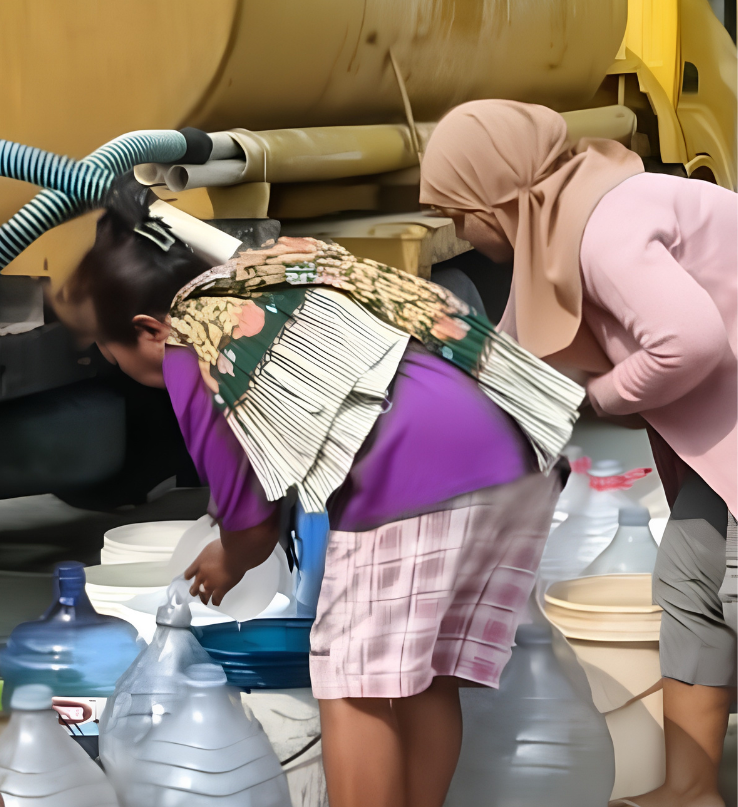
When a long dry season and drought struck, Mbok* Jum, an older woman in Gunungkidul, had to walk to find water or wait in line for tap water. These conditions prompted communities to work together to find a solution.
The call to prayer rang out, so I hurriedly got up and performed wudu to fulfill my duty to the Creator. After finishing my prayers, I immediately went to the market to buy vegetables and side dishes to make breakfast and pack lunches for my children and husband. As it happened, we were out of supplies at home. I hurried so I wouldn’t be late
The market, located about one kilometer from the house, is called Gojo Market. It is situated right in front of Gajasari Public Elementary School and near Kedungpoh Village. It is managed by the village government. Gojo Market isn’t very large, but it can accommodate dozens of sellers.
It was still dark outside, but the hustle and bustle of the market was already audible—the voices of sellers hawking their various wares, ranging from market snacks and vegetables to side dishes and household goods.
From the corner of the market, I faintly heard a voice that was all too familiar to me. The closer I got, the clearer the voice became. That distinctive voice and hearty laugh—which often sparked jokes that had the entire market roaring with laughter—belonged to Mbok Jum.
Up close, I could hear their conversation and jokes, which eventually turned into a heartfelt outpouring. Mbok Jum poured out her heart and voiced her complaints about the dry season that just wouldn’t end.
““When is it going to rain? It’s been days since the tap water has been running—forget about taking a shower; there isn’t even enough water to wash my face,” Mbok Jum lamented.
“Same here. The water doesn’t run where I live either,so everyone’s fighting over it,” replied Ratni.
The conversation continued back and forth, with not just the two of them but also those listening joining in. It turned out that the problem of clean water scarcity wasn’t felt only by Mbok Jum and Ratni—almost all market visitors and sellers were experiencing the same thing.
Water is a basic daily necessity. However, because of the extremely long dry season—with no rain in sight—water has become a new problem on top of the ones we already faced. Just like other basic necessities, it’s putting an even greater strain on our finances. Water has become the main problem for the women in my village.
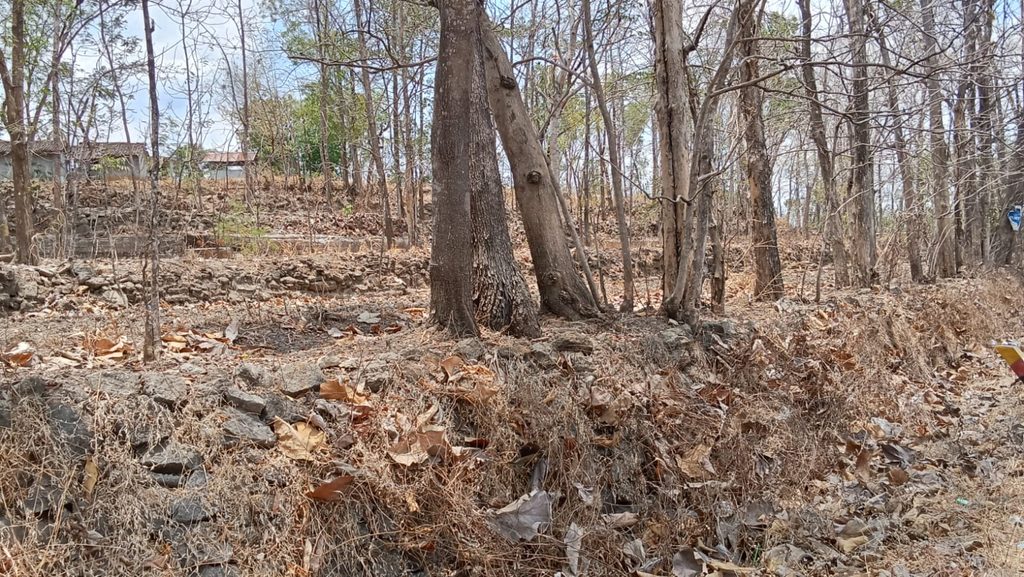
Kedungpoh Village is located on Nglipar Road in Ngawen, Gunungkidul, Yogyakarta. This area lies in the karst mountains and often suffers from drought during the dry season. The soil appears barren and arid, cracked all over. The grass has dried up, as have the springs.
Mbok Jum is an older woman who has reached the age of 80, but she is just as physically fit as women of working age. She still carries out her daily activities by selling coconuts, herbs, and produce from her garden or rice fields.
By selling goods, Mbok Jum provides for her family’s basic needs. She lives alone with her daughter, who has an intellectual disability, in a very modest home. When her daughter’s emotional state is unstable, Mbok Jum is often yelled at or hit. Yet Mbok Jum never complains; in fact, she acts as if nothing has happened.
Before heading to the market, she has to fetch water from a community well located some distance from her home. With her frail body, she carries the water container and walks through the still-dark, quiet morning to meet her family’s water needs.
The distance from Mbok Jum’s house to the spring is about 500 meters. The hilly terrain left Mbok Jum gasping for breath. She had to make at least three round trips carrying water in a clay jug.
A smile tugged at the corners of my mouth; I was in awe and full of admiration for Mbok Jum’s perseverance and struggle. She is in her twilight years; she should be enjoying her retirement, but she still has to struggle against the harsh realities of life.
““Before heading to the market, I already carried water for bathing and cooking,,” said Mbok Jum.
““Oh my God, aren’t you tired?” Narti gasped upon hearing Mbok Jum’s words as she browsed through the merchandise she planned to buy.
“Actually, I am tired, but what else can I do? There’s no water. If I rely on the municipal water supply, I have to wait two more days for my turn,.” Mbok Jum sighed with a resigned and pleading tone.
““Didn’t you get a water drop from the government? dropping ,” asked Poniyem.
“I waited in line but didn’t get any; on top of that, so many people are using it and need it too,” replied Mbok Jum.
“Let’s hope it rains soon, Mbok, so it won’t be even harder to find water,” replied another visitor.
And together, they all said amen to that prayer.
The number of older people in Kedungpoh Village accounts for nearly one-third of the total population. Meanwhile, people with disabilities make up six percent of the total population. They become an at-risk group when the dry season drags on and drought strikes.
The dry season almost always poses a unique challenge for some communities of Kedungpoh Village. When rain becomes scarce and water sources experience reduced flow, the community’s need for clean water becomes an issue that requires collective attention.
This situation has raised concerns among the young people who are members of the village youth organization. For these young people, the water issue is not merely the government’s responsibility, but a shared problem that requires care, mutual cooperation, and the involvement of all segments of society.
Driven by these concerns, village youth organization then coordinated and held discussions with community leaders, neighborhood unit heads, community heads, Family Welfare Empowerment, village heads, and other community members. Through deliberation and consensus, the idea emerged to independently secure a water source by drilling a well. The hope is that this can serve as one solution to meet the community’s water needs, especially during the dry season.
Once an agreement was reached, the next step was to seek support and donations. The village youth organization, together with community leaders, reached out to various parties—including government agencies, organizations, individual donors, and community leaders concerned about the community’s well-being.
The spirit fostered was not merely about seeking assistance, but about inviting various parties to work together to address the issues faced by the community.
The effort to drill a well was finally carried out. However, once the water source was put to use, it turned out that the water flow was insufficient to meet the needs of the entire community. This situation became the next challenge that had to be faced together.
The village youth organization did not stop there. Together with the Kedungpoh Village Government, they coordinated and communicated further to find additional solutions in the form of clean water assistance. Various parties were then contacted, ranging from the Regional Disaster Management Agency (BPBD), members of the Regional People’s Representative Council (DPRD), banks, organizations, social institutions, and other parties concerned about the community’s need for clean water.
This initiative was undertaken with the understanding that tackling drought cannot be done by a single party alone. It requires synergy among youth, community leaders, village governments, community organizations, the business sector, and various other concerned parties.
The efforts undertaken by village youth organization together with the Kedungpoh community are a tangible expression of social concern and the spirit of mutual cooperation. From a shared concern came deliberation, and from deliberation came action. Through these actions, a collective movement was formed to help the community cope with the water crisis.
This spirit proves that young people are not merely the next generation but also a vital part of the solution to the challenges facing society today. Through unity, compassion, and effective communication among the youth village organization, community leaders, neighborhood unit heads, community heads, Family Welfare Empowerment, village heads, and the Kedungpoh village government, it is hoped that the drought issue can be addressed collectively and sustainably.
Mbok Jum has also benefited from this community initiative and cooperation. She collected water jugs, buckets, basins, and a water storage at her home, which she gradually filled with water to build up a supply. This way, Mbok Jum no longer has to walk far to fetch water every day or wait her turn to fill her containers, allowing her to focus on her work as a seller.
From this, I can see that even small voices can be heard and can bring about change in the community. Because when water becomes a shared problem, compassion and mutual cooperation must also become a shared solution.
*Mbok is a traditional Javanese term of address used to refer to or address a woman, particularly an older woman.
Ria Yamawati Prastiwi
She is a housewife and is actively involved in the Family Welfare Empowerment in Kedungpoh, Nglipar, Gunungkidul, Yogyakarta.