
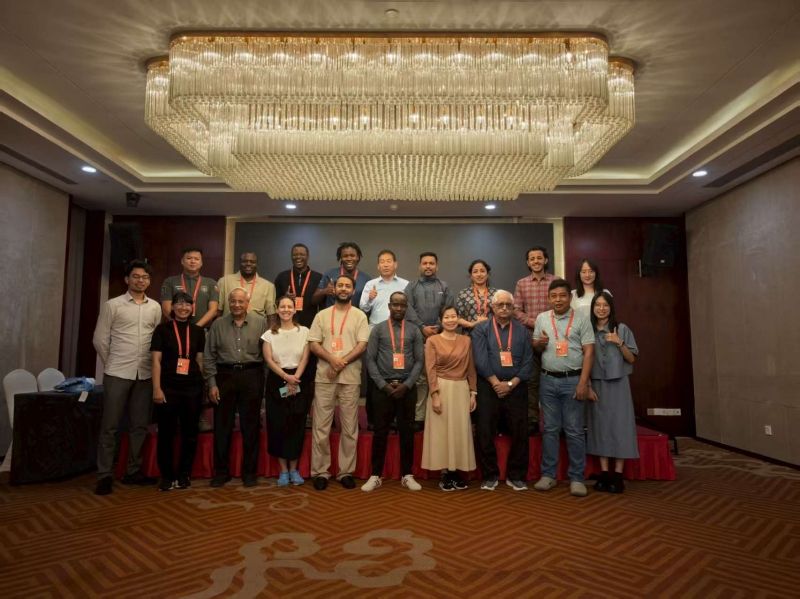
The second International Civil Society Exchange Conference on Joint Implementation of Global Development Initiatives was held on 9-11 September 2025 in Hohhot, Inner Mongolia, China. The conference, organised by China NGO Network for International Exchanges (CNIE) and the People's Government of the Inner Mongolia Autonomous Region of China, was attended by more than 300 participants from at least 50 countries who were involved in discussions on experiences and cooperation in poverty alleviation, health and welfare services, and humanitarian aid and volunteerism. YEU, as a humanitarian partner of the Amity Foundation, had the opportunity to participate in this event.
The networking event was held on 10 September 2025 and featured exhibitions from NGOs, government agencies and Chinese companies showcasing their best practices, products, programmes and services in China and overseas. The Amity Foundation participated in this event by showcasing its work in China and other countries in the fields of education, water conservation and environmental protection. Annual reports and products were displayed as part of the Amity Foundation's consistent efforts to achieve the Sustainable Development Goals.
The Guangzhou Institute for Urban Innovation (GIUI)—a think tank organisation that connects government, universities, think tanks, and social organisations to promote urban innovation—is using this event to announce the opening of registration for the 7th Guangzhou International Awards for Urban Innovation this October. The awards are intended for urban innovations developed by the government in collaboration with NGOs, academics, and other parties in the fields of social inclusion, environmental protection and resilience, public services and infrastructure, culture, and so on.
Meanwhile, the Hohhot Government also shared lessons learned in sustainable and integrated development models. With a population of 3.6 million, the capital of Inner Mongolia is the economic, cultural, scientific and educational centre of Inner Mongolia. The city has also succeeded in transforming barren grasslands into green spaces by increasing local vegetation that is climate-adaptive, water-absorbent and green areas. In 2022, Hohhot became a National Pilot City for Ecological Civilisation.
The thematic session held on 11 September 2025 featured more than 20 speakers divided into three panel sessions, highlighting the cooperation between China and other countries around the world on issues of public welfare and poverty reduction, health, humanitarianism and volunteerism. The speakers were quite diverse, representing philanthropists, NGOs, NGO associations, educational and health institutions from both China and other countries, ranging from Papua New Guinea, India, Pakistan, Malaysia, Algeria, Zimbabwe and others. Each of these associations/organisations shared their experiences and lessons learned from their cooperation in various fields, ranging from medical team training, supporting the "back to school" initiative by providing school supplies for children in Africa, humanitarian responses to disasters and crises, strengthening search and rescue teams, climate action campaigns, environmental protection through tree planting, to livelihood support. In this decade, China has increased bilateral and multilateral cooperation and raised substantial funds to support the implementation of development programmes in developing countries, in line with the Sustainable Development Goals and the Global Development Initiative.
The following day, YEU, along with other organisations from Asia, Africa, and Latin America, had the opportunity to visit Shaanxi in Xi'an Province and hold discussions with the Shaanxi NGO Forum, Shaanxi NGO Network for International Exchange (SNIE).& nbsp;As quoted on the wall of the SNIE office, SNIE believes that NGOs play an important role in promoting economic and social development as well as international cooperation and global governance. Therefore, SNIE encourages its 129 member organisations to participate in international exchanges in 14 areas of work, including economics, women's and children's protection, youth movements, environmental protection, tourism, health and socio-culture.
At this meeting, seven speakers from SNIE shared their experiences and cooperation in other countries, for example through economic empowerment innovation competitions, supporting women and children to study abroad, building/renovating schools, sports or cultural competitions to build youth leadership, cooperation in traditional Chinese medicine, developing eco-villages, providing safe drinking water facilities and rainwater harvesting, and climate resilience. These are China's efforts to contribute to the achievement of the Global Development Initiative. eco-villages, providing safe drinking water facilities and rainwater harvesting, and climate resilience. These are China's efforts to contribute to the achievement of the Global Development Initiative.
The Global Development Initiative was first introduced by Chinese President Xi Jinping at the 76th UN General Assembly in 2021. The concept was born to demonstrate China's commitment to accelerating the implementation of the Sustainable Development Goals and as an effort to address global challenges arising in the wake of COVID-19, ranging from geopolitical conflicts, climate change, crises to human rights and democracy conflicts. Along the way, the Global Development Initiative has gained the support of at least 70 other countries that are members of the Friends of the Global Development Initiative.
In principle, this initiative prioritises development, is committed to a human-centred, inclusive approach (no country or person left behind), is driven by innovation, ensures harmony between humans and nature, and is action-oriented. Climate resilience and green development are among the focus areas where China is increasing climate investment across its provinces, including through ecological protection and restoration and the incubation of research and technology-based innovation. China is investing heavily in programmes that focus on being "small but beautiful and beneficial to people's livelihoods".
Conceptually, this initiative is in line with the global agenda on Sustainable Development Goals, but its implementation strategy must continue to prioritise the principles of inclusion, gender equality and local leadership. Many sophisticated and efficient innovations and applied technologies have been developed based on research and scientific knowledge, but they have failed to address the root causes of problems in the most affected communities. YEU believes that ensuring meaningful participation from the most at-risk communities is as important as ensuring that innovations are born and grow within communities, supported by adequate resources and interconnected with one another.
——————-
Author: Debora Dian Utami – Director