
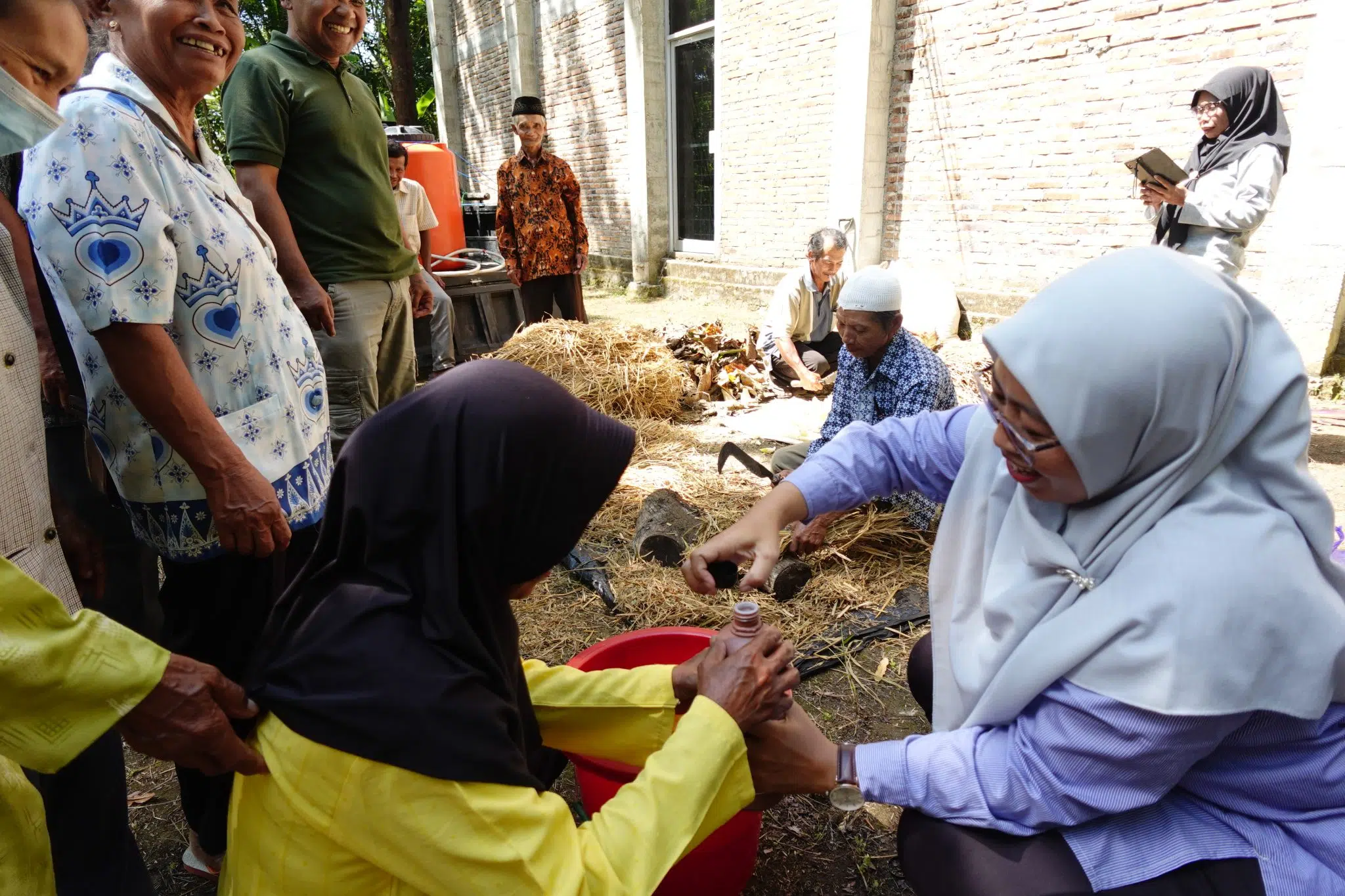
Photo by Devi: Participants in climate-adaptive agricultural techniques training organized by YEU in Banjarsari Village practice making fermented livestock feed together with the facilitator.
“During the dry season like this, the cows eat the goats, and the goats eat the cows.”
— Farmers’ group in Banjarsari Village, Kulon Progo
Banjarsari Village, located in Samigaluh District, Kulon Progo Regency, is characterized by a hilly landscape with relatively steep slopes. Water availability is one of the community’s biggest challenges, particularly during the dry season. As water becomes increasingly scarce, agricultural activities often have to stop, leaving farmers with limited options for maintaining their livelihoods.
Livestock farming provides an important source of income for families when crop farming is no longer possible. However, another challenge emerges as green fodder becomes increasingly difficult to find during the dry season. Community members often have to travel farther, sometimes even outside the district, to find sufficient supplies of green fodder, incurring significant transportation and purchasing costs. This situation is particularly challenging for the predominantly older farming population, many of whom are experiencing reduced mobility.
In some cases, farmers are forced to sell other livestock to purchase feed for their main livestock. This situation has even inspired a common joke among the community: “The cows eat the goats, and the goats eat the cows.”
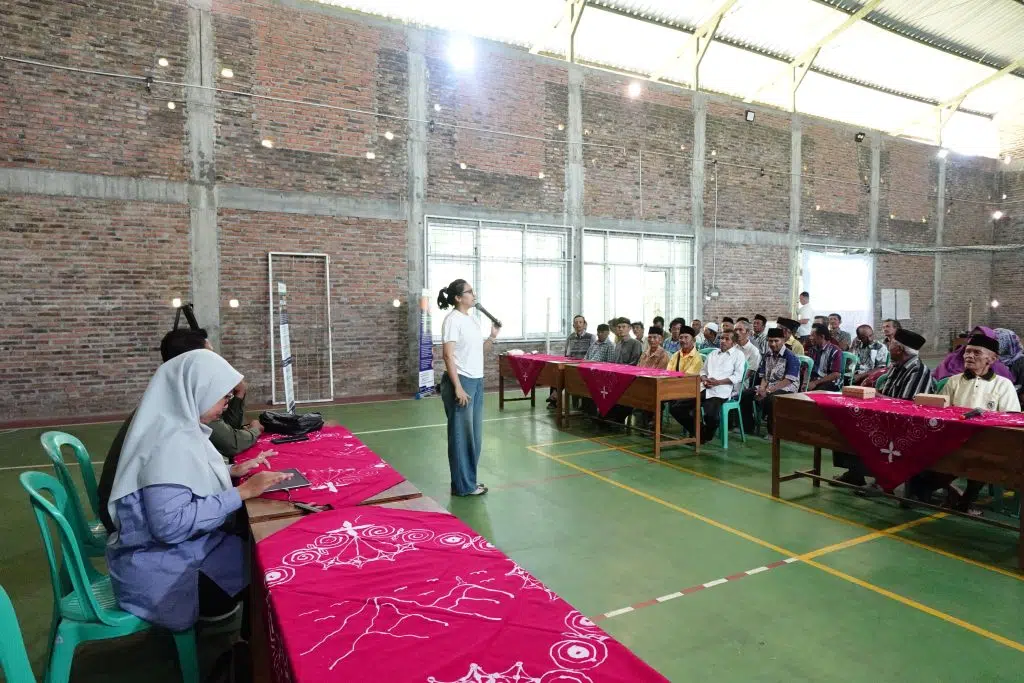
Photo by Devi: Climate-adaptive agricultural techniques training in Banjarsari Village.
To address this challenge, YEU worked with the community in Banjarsari to explore more climate-adaptive livelihood options amid increasingly unpredictable climate conditions. Training on producing alternative livestock feed through fermentation was introduced as one practical solution.
“We need to water crops four to five times each month. The hotter the weather becomes, the more water we need, and this increases agricultural costs,” she added.“We were very happy after taking part in the fermented feed training. Usually, we have to look for green fodder outside the village, sometimes even in another district. We can spend around IDR 1–1.5 million a month on feed. When we buy it together as a group, we have to rent a car for around IDR 250,000 and then share the transportation cost among us.””
— Seniran and Muryani, Farmers in Banjarsari Village
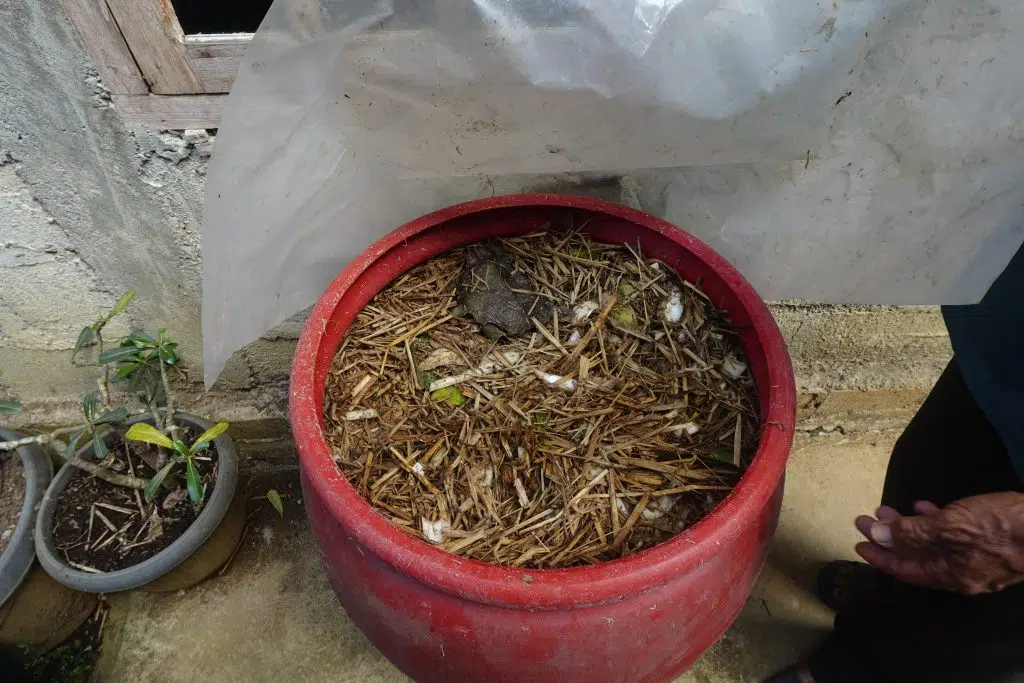
Photo by Devi: Fermented livestock feed produced by the farmers.
Fermented livestock feed is a technique for preserving animal feed using microorganisms, such as beneficial bacteria or fungi, while also improving its nutritional value. The technique is relatively simple to apply and has a low risk of failure. Farmers can use locally available agricultural residues, such as rice straw, corn cobs, banana stems, and dried leaves. This helps reduce the cost of obtaining livestock feed while making it more accessible within the community. The technique also allows farmers to preserve surplus feed during the rainy season and store it as a reserve for the dry season. In this way, feed that might otherwise go unused can become an important resource when green fodder becomes scarce.
Following the training, several farmers began practicing the technique independently, with some taking home the fermented feed they produced during the training. Although transitioning to fermented feed takes time—and livestock may initially be reluctant to consume unfamiliar feed—the response so far has been encouraging.
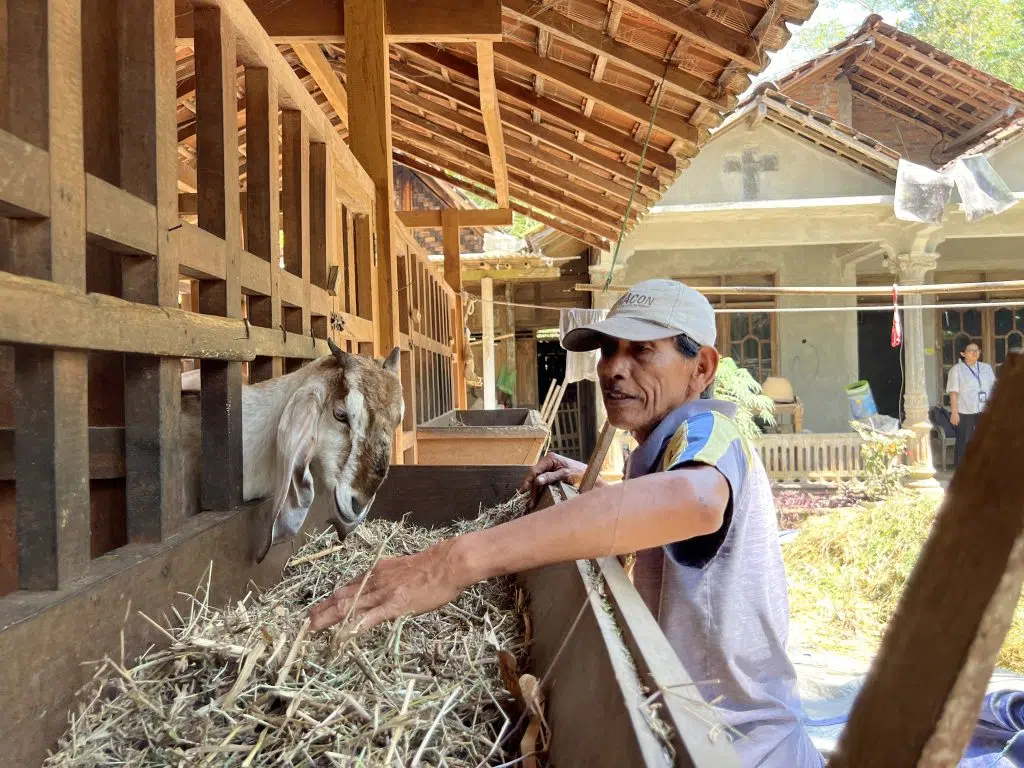
Photo by Devi: Rohman, a member of a farmer group in Banjarsari Village, provides fermented feed to his goats.
“I noticed a difference after using fermented feed. My livestock eat more eagerly, and their coats feel smoother.”
— Muryana, Farmer in Banjarsari Village
As the dry season is expected to become longer due to the impacts of El Nino, producing fermented livestock feed offers a simple yet practical way to strengthen farmers’ livelihood resilience. Even when the rainy season has ended, farmers can continue meeting their livestock’s feed needs by making use of materials available around them.
This training is part of the PROSPER project implementation. The project, titled “PROSPER: Promoting Resilient and Food-Secure Communities in Disaster-Prone Areas of Yogyakarta Province” is implemented by YAKKUM Emergency Unit (YEU), with support from AWO International and funding from the German Federal Ministry for Economic Cooperation and Development (BMZ) and the German Relief Coalition (ADH).