
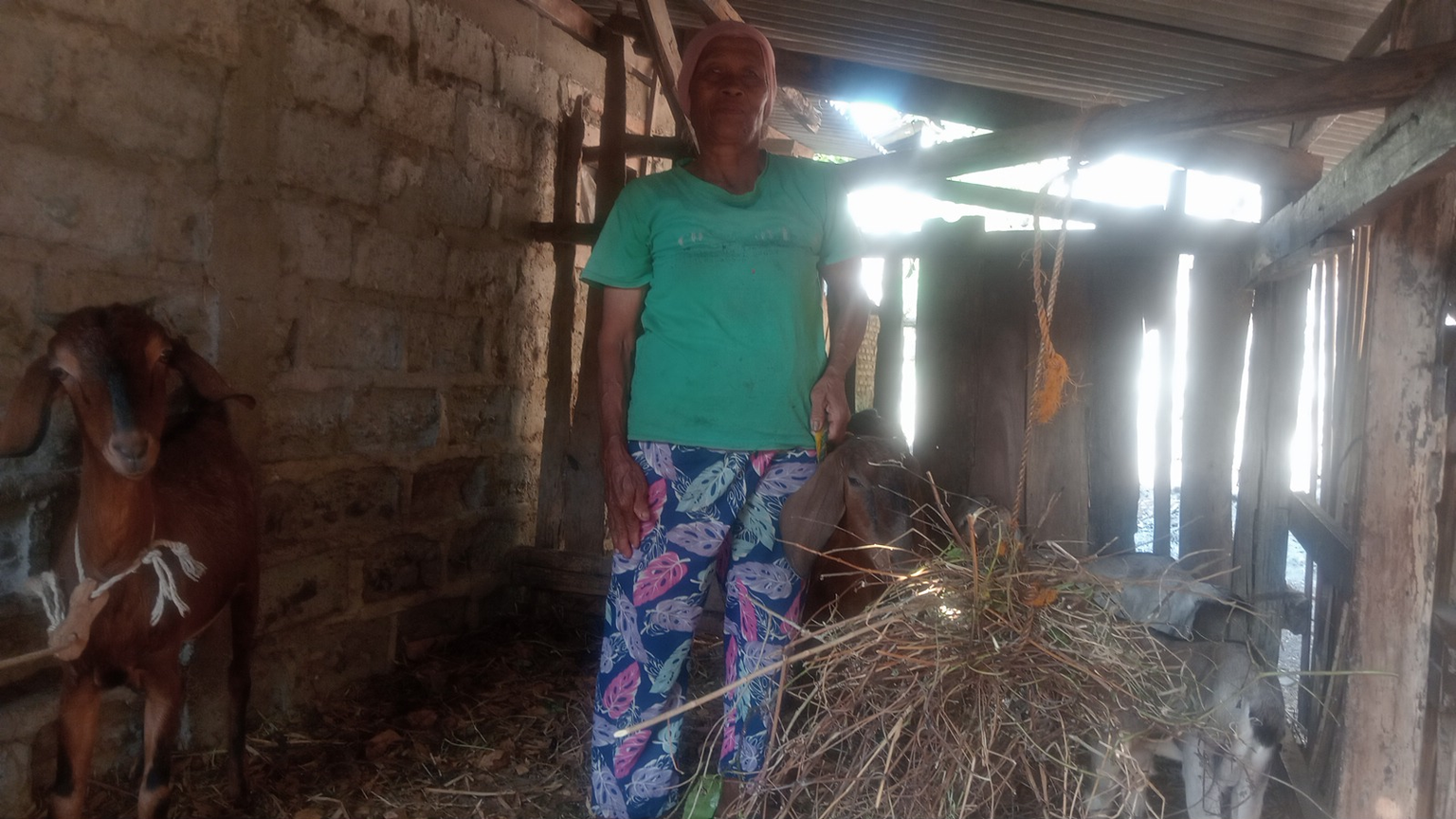
Every dry season in Gunungkidul, Tuminah worries about her goats, who struggle to find enough grass to eat and water to drink.
Tuminah lives in Gunungkidul, an area in Yogyakarta known for its dry and barren landscape during the dry season.
She is a widowed woman who finds companionship in her goats.
Mbok1 Tuminah, as we call her, lives with three goats named Belang, Hitam, and Putih. She cares for them as if they were her own children, making sure they have enough food and water to live comfortably.
Mbok Tuminah lives in Wuni Hamlet, Giricahyo Village, Purwosari Subdistrict, Gunungkidul, Yogyakarta. Despite her advanced age, she still works as a farm laborer. She spends her days working in the fields and actively participates in the Women Farmers Group (KWT) in Wuni Hamlet.
She used to live with her older sibling. However, after her sibling passed away, she was left living on her own, with only her goats for company.
Every morning, Mbok Tuminah goes out to collect grass to feed her goats. After returning from gathering fodder for her 3 goats, she works as a hoeing laborer in her neighbors’ fields. She earns just IDR 30,000 a day. Although this amount is barely enough to cover her daily needs, she continues working with determination.
This year, the dry season has been particularly long, lasting from June to September 2026. For three months, no rain has fallen over Giricahyo. In previous dry seasons, she could still find grass in the gardens, along with wild grass, cassava leaves, and jackfruit leaves that she could cook for herself and set aside for her goats. Now, the gardens have become barren. The soil is cracked, and the grass has withered before it could grow back. The prolonged drought has made life harder for her 3 goats, which now struggle to find enough grass and have limited access to water.
Gunungkidul is one of the driest areas in Yogyakarta, as much of its landscape is dominated by limestone hills and karst formations. Much of the region consists of limestone rock, which makes water scarce and leaves the area vulnerable to drought during the dry season. The dry conditions have also shaped local food habits, with cassava becoming a staple in many households. Although there have been efforts to improve degraded land and provide water assistance, the soil still becomes extremely dry whenever the dry season arrives.
Mbok Tuminah usually wakes up at around five in the morning. But instead of preparing breakfast, she gets ready to queue for water. A water tanker arrives once a week, and each household typically receives four jerrycans of water. This water is used for cooking, drinking, performing ablution (wudhu), and giving to her goats.
Living with recurring droughts has taught people in Gunungkidul to prepare and store water. Some rely on clean water supplied by tanker trucks, while others collect and store rainwater. Rainwater harvesting has become essential in several parts of Gunungkidul, where the land is extremely dry and stored rainwater often serves as an important source for daily needs.
Her 3 goats are precious to Mbok Tuminah. Especially during a drought like this, they are always on her mind.
She originally received her goats through a rotating livestock savings scheme organized by the Women Farmers Group (KWT). She also once received a goat through a similar scheme funded by YAKKUM Emergency Unit (YEU). She bought Hitam and Putih (Black and White) using the money she earned from selling her harvested corn. Mbok Tuminah has been a member of the KWT for 8 years.
But finding food for her goats has now become increasingly difficult. She has to walk 2 kilometres uphill to look for leaves that still retain a little green. By the time she returns, she can only carry home one sack of dry leaves. Her back often aches from the effort.
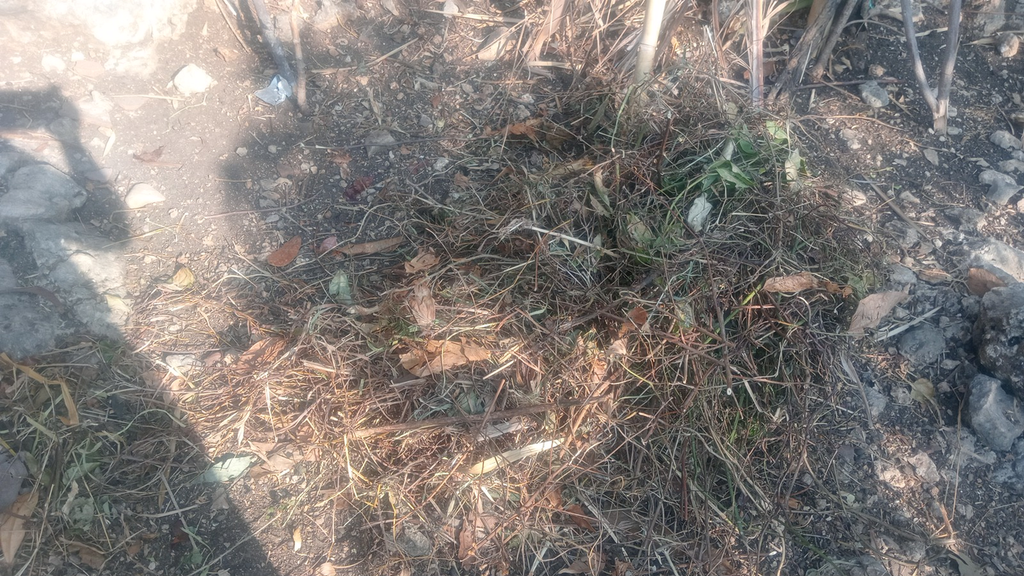
Photo 1. The dried leaves Mbok Tuminah gathers to feed her goats.
“I'm sorry, Le2, you don't get as much food as you used to this year,” she whispers while gently stroking the head of Putih, one of her goats.
The drought has dried up the leaves around her village, leaving the goats with little choice but to eat whatever dry leaves they can find.
“The hardest part is when the water for the goats runs out before anything else.”
Mbok Tuminah then tries to save the water left over from washing rice and gives it to her goats in a small bucket. Her neighbors often tell her to sell the goats so that caring for them will no longer be a burden.
“Bu, why don't you just sell the goats rather than let them starve to death?”
Mbok Tuminah simply smiles, “if I sell them, who will I spend my time with?”
One night, Hitam became weak and refused to eat. Mbok Tuminah stayed up all night, turning on her flashlight and feeding the goat with sugar water, spoonful by spoonful.
“Stay strong, Le. I have made a promise that we will live together, side by side.”
The prolonged dry season has clearly made it difficult for Mbok Tuminah to find fodder for her goats. Every morning at around seven, she heads out to collect whatever she can find. With the drought continuing, she has had to feed her goats with dried leaves, particularly melinjo leaves (Gnetum gnemon).
One morning, I was surprised to see that Mbok Tuminah's goats had suddenly grown in number from three to five.
The following day, during a KWT meeting, an agricultural extension officer came to teach the members how to make fermented animal feed using rice straw and rice bran. They also learned how to make a drip-feed drinking system for livestock to prevent water from being wasted. Mbok Tuminah carefully wrote down everything the officer explained in her notebook. Her hands trembled, but her eyes were full of enthusiasm.
A month later, a small miracle arrived. It rained for 20 minutes. The rain was not particularly heavy, but it was enough to fill a bucket with water. Mbok Tuminah and her three goats were soaking wet in the yard. She laughed as Belang jumped around excitedly.
Mbok Tuminah also recently told me that she had considered selling her goats. However, goat prices were still low, so she decided not to go ahead with the sale. She actually needs the money to cover her daily expenses. Still, she remains grateful that the income she earns from working in the fields helps her meet her everyday needs. For now, she can put off selling her goats.
Now, Mbok Tuminah has learned to make her own livestock feed using fermented dry leaves and rice bran. At last, she can better meet her goats' nutritional needs.
I feel fortunate to have Mbok Tuminah as my neighbor. She lives a simple life, finding companionship and joy in the presence of her goats.
Thank you, Mbok Tuminah, for teaching us about loyalty and love for the animals we care for.
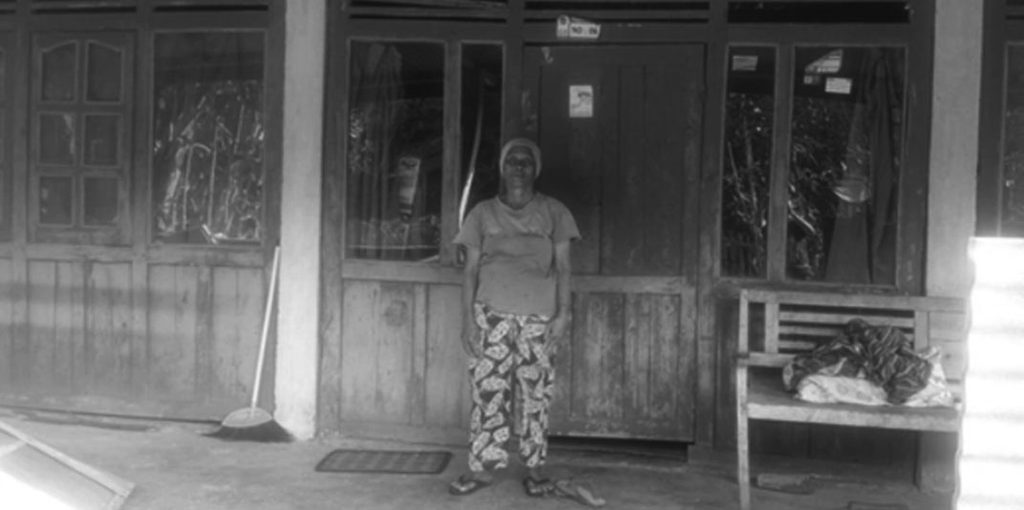
Photo 2. A portrait of Mbok Tuminah in front of her house.
Editor: Luviana Ariyanti
This article has been published on the Konde.co website and is a collaboration between YAKKUM Emergency Unit (YEU) and Konde.co through the #Kedip (Konde Women's Digital Literacy) programme.
- Mbok is a traditional Javanese term of address used to refer to or address a woman, particularly an older woman. ↩︎
- Le is a familiar and affectionate form of address derived from the word “Thole” in Javanese culture, traditionally used to call a son, a boy, or a younger male. It can also be used as a nickname for male animals, such as a male goat, reflecting a sense of familiarity and affection toward the animal. ↩︎