
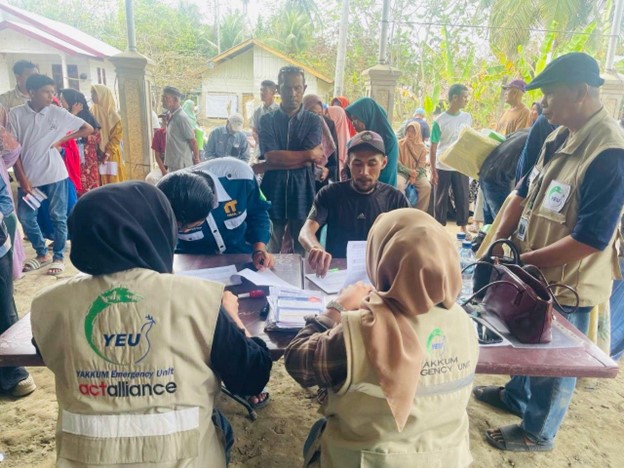
Under the roof meunasah (community prayer hall) in Pante Baro Kumbang, that morning felt busier than usual. Hundreds of residents gathered, waiting for their turn to receive assistance. Among the long queue, Umar* (8) and Zikri* (5) sat side by side, their legs gently swinging, occasionally glancing toward the entrance.
“Taking a long time, isn’t it?,” whispered Zikri, half-complaining.
Umar simply nodded, then returned to focusing on a sheet of paper in his hands.
With a pencil that had begun to dull, they drew a house—walls, roof, and door—as simply as they remembered. At times, they laughed to themselves, showing each other their drawings, as if the world around them were not in a state of recovery.
Not long before, their home had been flooded. Mud had seeped inside, leaving damp walls and a lingering odor that had yet to fully disappear. Since then, their daily routines have changed. Play was no longer as free as it used to be, and the space at home felt different.
“They used to play in the yard; now they spend more time indoors or go to the meunasah,” said one resident.
That morning on 16 February 2026, they came with their family to wait for assistance distributed by YEU with support from Peace Winds Japan (PWJ). The distribution was delayed for about an hour and a half to ensure all packages were complete. But for Umar and Zikri, time seemed to pass differently—filled with drawings, stories, and small bursts of laughter.
Occasionally, they stood up, trying to look toward the front of the line. Then they sat down again, waiting once more.
When the assistance was finally distributed, their family received a Shelter Kit and a Hygiene Kit. For adults, it meant more proper bedding, protection from the cold, and hygiene supplies to prevent disease. But for Umar and Zikri, it may have meant something simpler—a home that felt a little more comfortable and days slowly returning to how they used to be.
In their village, recovery is not yet complete. Some sanitation facilities are still not fully usable. Residents continue to adapt, share, and make do with what they have.
But amid all of this, there is something that endures.
Laughter.
Umar and Zikri’s laughter—marked by their missing teeth—burst through the crowd in the meunasah. Light and unburdened, as if they were reminding those around them that hope does not always come in big ways.
Sometimes, it appears in small things.
In a drawing of a house on a piece of paper.
In simple stories.
And in two children who still choose to smile.
Note: The children’s names have been changed. This story was written with the family’s consent and does not reveal specific identifying details of the children, as part of a commitment to protection and safeguarding.