
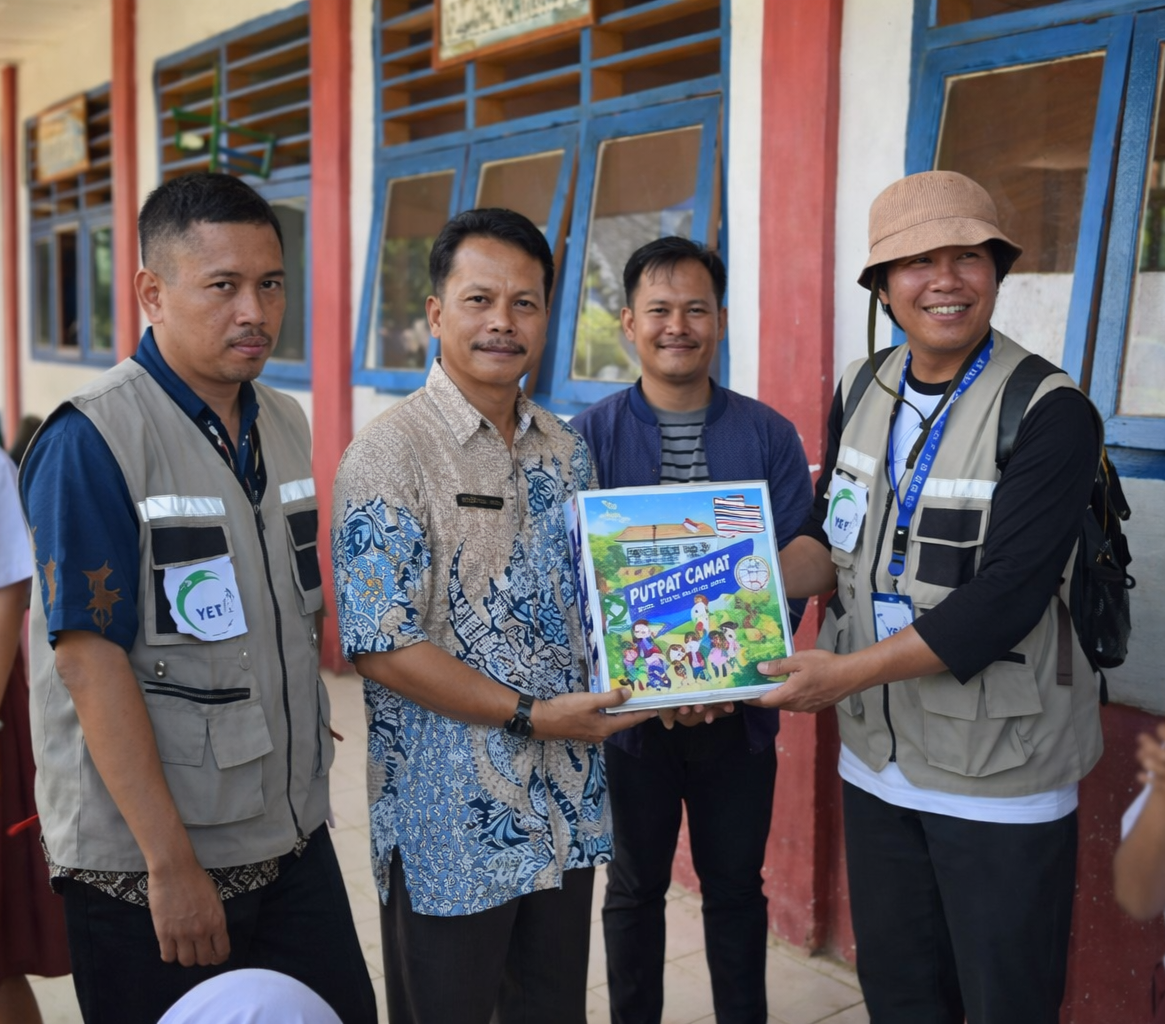
Central Tapanuli was still in the recovery phase when Andi Joko Prasetyo first set foot there. The flash floods had passed, but their aftermath remained; schools still stood in a state of disrepair, and some children were studying in temporary shelters and emergency tents.
The original plan was to visit several elementary schools with Putpatcamat, an interactive disaster education game developed by the local innovator IDEAKSI 2.0, namely PPDMS (Pusat Pemberdayaan Disabilitas Mitra Sejahtera) in Gunungkidul.
Putpatcamat was originally designed only for elementary school students. However, in practice, participants have ranged from preschoolers to middle and even high school students. Some play in makeshift classrooms, others in tents near residents’ homes, and still others in their usual play areas. A total of six Putpatcamat units—including both electric and standard models—are distributed across four schools, one temporary shelter, and two community sites.
There are three things that Mas Andi brought back from Central Tapanuli.
First, regarding education. Some middle school students have difficulty answering the Putpatcamat questions—which were designed for elementary school students—because access to education has not yet reached remote areas, especially during emergencies.
Second, regarding language. The terms commonly used to describe disasters in the Central Tapanuli region have their own pronunciations here. Communication and the transfer of knowledge require some adjustment.
Third, and this is what made the biggest impression on Andi. In the middle of the play session, they spoke plainly: deforested forests, mines, illegal mining—all of that is what caused the flash floods. The children, who might have been thought not to understand, actually had a keen environmental awareness.
There was a moment Andi could never forget. While other YEU volunteers were distributing supplies at the temporary school, parents were dropping off their children in a corner of the room. Amid all the hustle and bustle, the children sat in a circle in front of the sub-district head because they wanted to play.
Teachers have testified that Putpatcamat is different. Previously, even though there had been disaster preparedness training from both the school and the community health center, the students would just sit there quietly. There was no interaction; they were passive. With Putpatcamat, the children are very enthusiastic and happy. The atmosphere has become much livelier.
After seeing all that, the parents had a simple request: “Next time, don’t just make it for the kids, sir—we want to play and learn too,” concluded one of the community.
The psychosocial impact of this response didn’t happen overnight; it manifested in simple ways. For example, there was a moment when Andi ran into the children who used to play Putpatcamat; they ran toward him and shouted: “Let’s play Putpatcamat again, Sir!”
That sentence is short. But for Andi—and for anyone who has ever worked in a disaster situation—children who are willing to shout again, run again, and invite others to play again are the most honest sign that something important has returned: a sense of safety.